Consultants, for the most part, can be a tremendously valuable resource. Or, if badly selected, they can be as Arnold H. Glasow (1905-1998) – frequent and long-time contributor to the Wall Street Journal, Fortune Magazine and Readers Digest , says “A consultant is someone who saves his client almost enough to pay his fee.” He was being kind, I think.
Lets talk about management system consultants, in particular. These include folks who help set-up ISO-compliant systems, or help maintain them. And I’ll make a quick disclaimer here – I don’t get any kind of monetary kick-back for recommending any consultants (but yes, I’ve done a little bit of it myself – though never for my Registration clients). I don’t mind telling you, for free, that they’re a good idea.
Let’s look at why a consultant is a good idea.
I’ve become familiar with, literally, hundreds of companies in my twenty-five year career in quality. Not the “Hi Randall, how’s the kids? Terrific, glad to hear it.” kind of familiar – I mean the, “Hi Randall… show me your procedures, records, management meeting minutes, goals, objectives, customer satisfaction data, factory processes, lunch menu and hey, how are those kids of yours doing?” kind of familiar.
Well over one-hundred of them several times each within the past few years alone – and the best ones, have all used, or are currently using, the services of a consultant.
And by “the best ones” I mean that they consistently get better over time; they’re able to find opportunities for improvement, and they are able to convert those finds into gold by managing them, trending them, utilizing solid root-cause techniques and executing any actions in efficient ways. They try new things, they keep up – they get better.
It is of course possible to do all this without help from the outside world – but it has proven to be a rare, near-mythical; “management system unicorn”. And it isn’t that the quality leadership in the less successful companies don’t have the required skills – they mostly do – but there is a different perspective that a consultant brings. And what they say, if they’re worth their salt, is generally listened to with more focused ears. Money talks back.
I will say that while most of the work I’ve seen is quite good, there are exceptions. The “what in the heck was this supposed to be?” kind of exceptions. Like the fresh ISO 9001:1994 installation on a planet where ISO 9001:2001 had grown stale and ISO 9001:2008 was being mandated – I know a twelve-year-old who knows what planet that guy was from.
Or the less obvious, but possibly more damaging, audit “nonconformances” that were clearly a product of another consultant’s imagination. And, less irksome, but troubling – the ones that miss opportunities completely. It’s not all their fault, sometimes a horse is too distracted to know it’s dehydrated – and, when told of impending death, is satisfied with a nice photograph of water. It is a rare thing to find a talented and inspirational consultant.
The problem is that one bad consultant tarnishes the reputations of many great ones.
How to get a good consultant.
Beyond the common sense, due-diligence, buyer-beware kind of advice (at least make an effort to do some vetting; call some references) there are a few good resources.
One is an actual ISO standard, ISO 10019:2005, “Guidelines for the selection of quality management system consultants and use of their services”
While it is somewhat dated, it was reviewed this September by the technical committee that controls it (ISO/TC 176/SC 3) and no changes are pending.
The scope reads something like this, “This International Standard provides guidance for the selection of quality management system consultants and the use of their services. It is intended to assist organizations when selecting a quality management system consultant. It gives guidance on the process for evaluating the competence of a quality management system consultant and provides confidence that the organization’s needs and expectations for the consultant’s services will be met…. This International Standard addresses the realization of a quality management system but, at the same time, could be used with appropriate adaptation for the realization of any other management systems.”
A good indication of the content of the standard is provided by its section 4.1.3
Evaluation of the competence of the consultant
When evaluating the competence and suitability of a consultant, due consideration should be given to
a) personal attributes (see 4.2.2),
b) relevant education (see 4.2.3),
c) knowledge and skills necessary to meet the organization’s overall objectives for the quality management system (see 4.2.3, 4.2.4 and 4.2.5),
d) work experience (see 4.2.6), and
e) ethical behaviour (see 4.3).
It also describes useful bits such as what should be in the contract for the consultant’s services (5.2), and typical activities of quality management system consultants (Annex A).
If you’re considering a consultant, ISO 10019 is easily worth the investment of about 90 USD (I really have to find out how to get a piece of that!).
Another great resource is a website called Elsmar Cove. Actually it is an excellent resource for a lot of things such as discussions of various regulatory affairs issues, manufacturing issues, and other quality assurance related tools and aspects – Business Systems are the focus.
It is a set of forums, where members (membership is free) ask and answer questions – it is self-policing and generally a safe place to ask for help.
The forum you may find handy is this one: ISO 10019 – Consultants and Consulting. Consultants post their availability and folks ask for consultants in particular locations, that kind of thing. I probably should say, if you happen to find a consultant based on this advice, I take no credit or blame for their work. Just in case something crazy happens…
There, some resources for you if you decide to fortify your company’s abilities with a qualified consultant – ISO 10019 and Elsmar Cove.
Here are a few ways you might begin using a consultant.
- Supplementing your internal audit resources with an external auditor. I don’t really recommend replacing your own internal audits, but a periodic fresh perspective can be invigorating.
- Targeted training on a tool or technique, such as 5 Why’s, kaizen events, 8D’s, FMEAs – etc.
- If you’re currently certified to one standard, such as ISO 9001, a consultant can make (relatively) quick work of adding the infrastructure to support other ISO standards – adding 14001 (environmental) or 18001 (health and safety) are probably easiest. Especially handy if you’ve inherited your current system.
- Helping to select a Registrar. Likely worth a post in itself, but consultants tend to work with several Registrars and get a feel for who might be a good fit for whom.
Whether you’ve considered hiring a consultant, and have been on the fence, of if the possibility has never entered your mind – I hope this post helps you to take the next step.
Good luck, go forth, and calibrate thyself.
Sal





 “Plans are nothing; planning is everything.” – Dwight D. Eisenhower
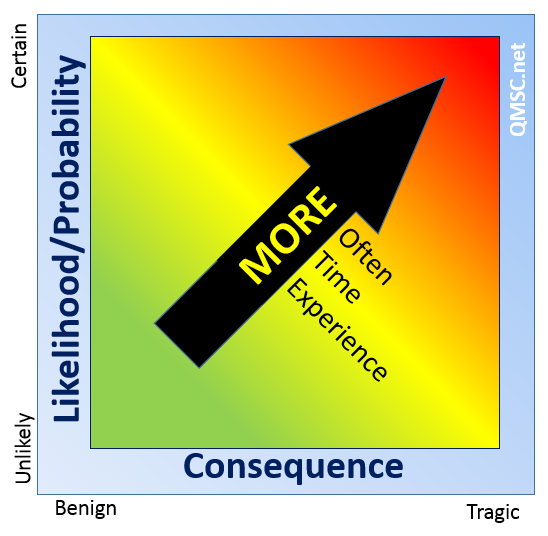 And, after doing that – the effectiveness of this plan must be evaluated. The standard goes on to say, essentially, that the actions must be proportionate to the effects. A note suggests avoidance, mitigation and acceptance as options for dealing with risk. Bigger risk should equal stronger planning.