


I try and keep an eye out for the release of new ISO standards, and sometimes I see one that is particularly interesting or shareable. Well, interesting to me, anyway.
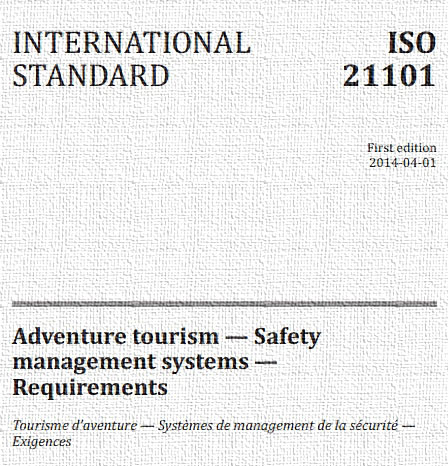 One of the things that separates 21101 from the crowd of similar management standards is that the target audience is potentially consumer-based. Typically the adoption of a standard is a pass-down requirement from one company to another. Ideally, though less frequently, a company will adopt a standard because they know it will make them more competitive.
I do believe it is a bit of a combination, since a hotel chain, for example, might require an adventure tourism service provider be so Certified.
The introduction to ISO 21101 claims adventure tourism is a global industry of growing importance, and that adventure tourism involves an inherent element of risk. There must be a balance between risk and reward; adventure and danger. ISO 21101 and it’s sister standards 21102 (“Adventure tourism – Leaders – Personnel competence”) and 21103 ( “Adventure tourism – Information for participants”) provide a basis for adventure tourism activities providers to plan, communicate about, and deliver adventure tourism activities as safely as practicable.
We’re talking about ziplining, mountaineering, rock climbing and other “I paid money for this kind of abuse?” type of non-work activities. Apparently, in contrast to work, pretty much anything else serves as relaxation.
I’m not sure how the release of the standard will impact the industry, but I’m hopeful. I was able to find an article in an industry journal from last year, “Trailblazerguide.com”; specializing in white water kayaking and rock climbing in South Africa. Quite an enjoyably informative site, by the way. They posted an article in June of 2013, “Wake up call for adventure companies” describing the standard’s impending release and I believe, based on the comments, that the response was generally supportive.
The standard is also interesting because it complies with Annex SL (I’ve added it to the list I supplied in the related Annex SL blog post: here).
Without giving away too much detail (or reproducing the standard for free – which is frowned upon) here is the table of contents. Note how closely it aligns with some of the newer standards, including the DIS of ISO 9001:2015.
21101 Contents – Adventure Tourism
1 Scope
2 Normative references
3 Terms and definitions
4 Context of the organization
4.1 Understanding the organization and its context
4.2 Understanding the needs and expectations of interested parties
4.3 Determining the scope of the adventure tourism safety management system
4.4 Adventure tourism safety management system
5 Leadership
5.1 Leadership and commitment
5.2 Policy
5.3 Organizational roles, responsibilities and authorities
6 Planning
6.1 Actions to address risks and opportunities
6.2 Adventure tourism safety objectives and planning to achieve them
7 Support
7.1 Resources
7.2 Competence
7.3 Awareness
7.4 Communication
7.5 Documented information
8 Operation
8.1 Operational planning and control
8.2 Emergency preparedness and response
8.3 Managing incidents
9 Performance evaluation
9.1 Monitoring, measurement, analysis and evaluation
9.2 Internal audit
9.3 Management review
10 Improvement
10.1 Nonconformity and corrective action
10.2 Continual improvement
Annex SL and Adventure Tourism
Fairly close to Annex SL, isn’t it? You can see, using the standard for Adventure Tourism, the power of the Annex; how it can make an unfamiliar management system mostly familiar – only the specific requirements change.
Maybe the next time you’re on vacation thinking about that wilderness hike, or the bungie jump into the volcano (really?) – consider asking if the provider is ISO 21101 Registered.
I for one, wouldn’t dream of a jumping into lava unless the company absolutely was 21101 registered – call me crazy.
Until the next Standarday (whenever that is) – thanks again.
Thank you for referencing my blog! I have spent considerable time around adventure companies in South Africa. Based on my experience the 21101 standard is applicable to high end adventure tourism operators (cruise lines, luxury yachts, operators targeting the high income groups). These enterprises will find benefit from the standard and I expect them to adopt it with relative ease. It may very well become a condition for trade in this niche-within-a-niche sector, similar to ISO14001 for heavy industry and mining.
Smaller owner/operator adventure companies will probably not adopt the standard. They work on smaller margins and do not reach the economies of scale that allows them to apply resources to labour intensive administrative tasks. They simply do not have the financial strength to afford external auditors. Keep in mind however, that these companies / individuals are often market leaders and experience beyond compare. These operators are not in it for a ‘job’ but rather as a passion and calling.
The challenge for the smaller companies is how to distinguish themselves from irresponsible fly-by-night operations. Their current method relies heavily on word of mouth.
Getting the smaller companies on board will require pressure from the middle income groups. But at the moment this sector does not even insist on seeing an operator’s public liability insurance.
Really great to hear your insights – was hoping you’d see the incoming link! I do hope the adoption of the standard expands, but yes, it is a commitment to pursue it. Even in the manufacturing world, it is a rare breed that seeks registration on the ideal that it will make them more competitive as well as marketable.
Thanks again!
Sal