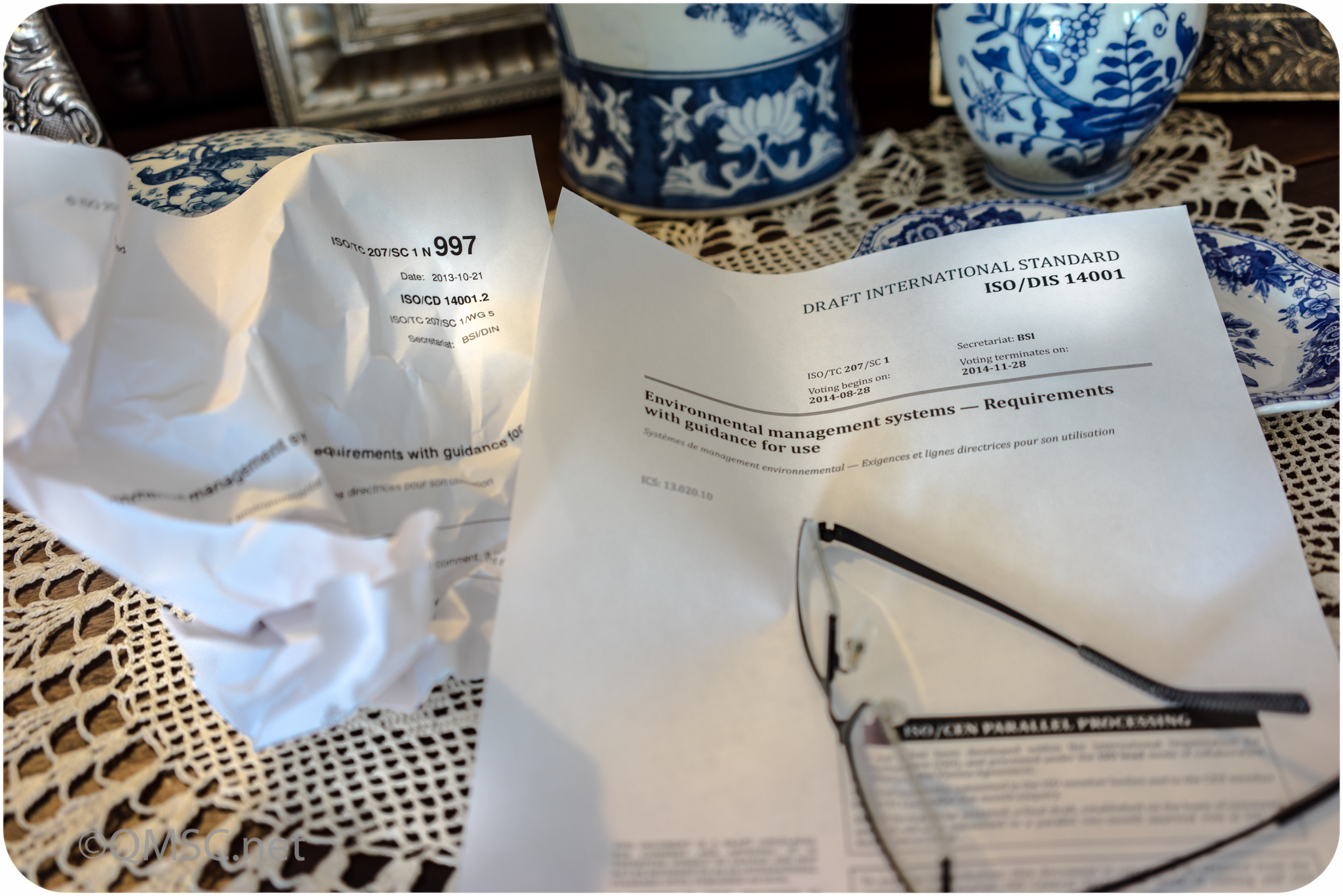
 DIS 14001 was released last week. Its arrival is another step toward ISO 14001:2015, scheduled for sometime next year. I’ve been reviewing it against the current 2004 version and there are some interesting changes.
Last post covered the first half of the Definitions section where the same words exist between DIS 14001 and 2004 – but they have either different meanings, or are augmented by different notes.
And, along with the release schedule for ISO 14001:2015, we looked at the overall structure, recognizing that DIS 14001 relies heavily on the basic skeleton of Annex SL.
In this part, coverage of the Definitions section continues, specifically of the new words.
Let’s get to it.
New words defined in DIS 14001
These are words that do not appear to be formally defined in the current version. Most of these do not show in Annex SL either, or I would not bring them up. Three fall into the latter category.
audit
Similar to “process” (below), audit is defined in Annex SL but not in 2004 – but there are differences in the notes in DIS 14001 (indicated in blue). Here is the whole piece for context:
3.28 – systematic, independent and documented process for obtaining audit evidence and evaluating it objectively to determine the extent to which the audit criteria are fulfilled
Note 1 to entry: An internal audit is conducted by the organization itself or by an external party on its behalf.
Note 2 to entry: An audit can be a combined audit (combining two or more disciplines).
Discussion: an aid to Registrars and organizations alike as often ISO 9001 and 14001 are audited simultaneously. This should allow for some economies of scale during the audit process, such as not auditing Management Review twice; once for 14001 and again for 9001.
As an aside, and to those on the inside – I don’t know how this impacts MD5 (if at all).
Note 3 to entry: Independence can be demonstrated by the freedom from responsibility for the activity being audited or freedom from bias and conflict of interest.
Discussion: Another clarification as this concept has caused difficulties in the past. Folks often go “overboard” in this regard; disqualifying those who only have a peripheral association with a function.
Note 4 to entry: “Audit evidence” consists of verifiable records, statements of fact and other information relevant to the audit criteria, and “audit criteria” are the set of policies, procedures or requirements used as a reference against which audit evidence is compared, as defined in ISO 19011.
Discussion: A clarification based on numerous [mis]interpretations.
continual improvement
Just like “process” (below) and “audit” (above), continual improvement in DIS 14001 adds information in the notes that does not appear in either Annex SL or in 2004.
3.29 – recurring activity to enhance performance
Note 1 to entry: Enhancing performance relates to the use of the environmental management system in order to enhance environmental performance consistent with the organization’s environmental policy.
Note 2 to entry: The activity need not take place in all areas simultaneously, or without interruption.
compliance obligation
3.22 – requirement that an organization has to or chooses to comply with Note 1 to entry: Obligations may arise from mandatory requirements, such as applicable laws and regulations, or voluntary commitments, such as organizational and industry standards, contractual relationships, principles of good governance and community and ethical standards.
[Source: ISO/DIS 19600:2014, 3.31]
environmental policy
3.6 – intentions and direction of an organization as formally expressed by its top management related to environmental performance
Nothing in the 2004, and this DIS 14001 definition differs only slightly from that defined in Annex SL by preceding it with “environmental and adding “related to environmental performance” to the end.
indicator
3.33 – measurable representation of the condition or status of operations, management or conditions
[SOURCE: ISO 14031:2013, 3.15]
life cycle
3.15 – consecutive and interlinked stages of a product system, from raw material acquisition or generation from natural resources to end-of-life treatment Note 1 to entry: Life cycle includes activities, products, and services and may include procured goods and services, as well as end-of-life treatment of products and delivery of services, for example, design, manufacture, transport, packaging and end-use or disposal.
[Source: ISO 14044:2006, 3.1, modified ― refer to ‘end-of-life treatment’, not ‘final disposal’, Note 1 to entry was added].
process
I would not have included this as new even though it doesn’t appear in 2004 because it is covered in Annex SL – however it does add a note; so I’ve added it in this section.
3.26 – set of interrelated or interacting activities which transforms inputs into outputs
Note 1 to entry: Processes can be documented or not.
Until next time
There’s your review of the changes in DIS 14001 relative to the overall contents and, mostly, the Definitions section. Next post I’ll cover another section of the DIS standard, or two.
Thanks for stopping by!
Sal
P.S. While this is my own independent blog, I would be remiss if I did not point out that if your company is in fact starting down the path to Certification, regardless of the standard, and are in need of a Registrar – I happen to know a great organization that does that kind of thing: Start here at TUV USA (part of TUV Nord).
Mention my name, please – so they’ll think I’ve been up to something useful in my spare time.