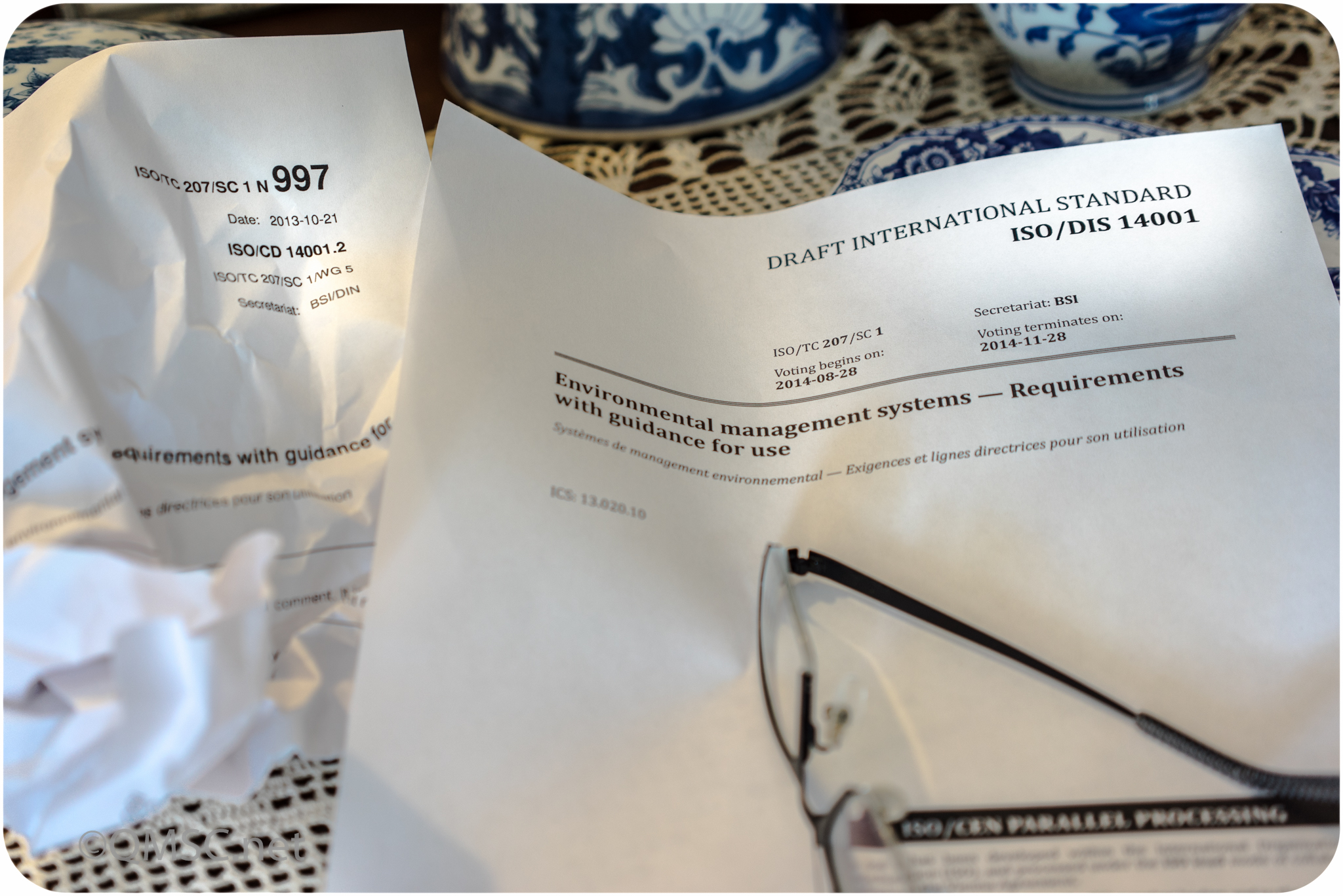
 DIS 14001 was released on July 1st and it represents the latest iteration of the Environmental Standard. I’ve been reviewing it against the current 2004 version and there are some interesting changes.
This first part covers the overall contents, but primarily looks at how the Definitions section has evolved.
Timeline for ISO 14001:2015
First, a quick timeline summary of the process; actual and planned. 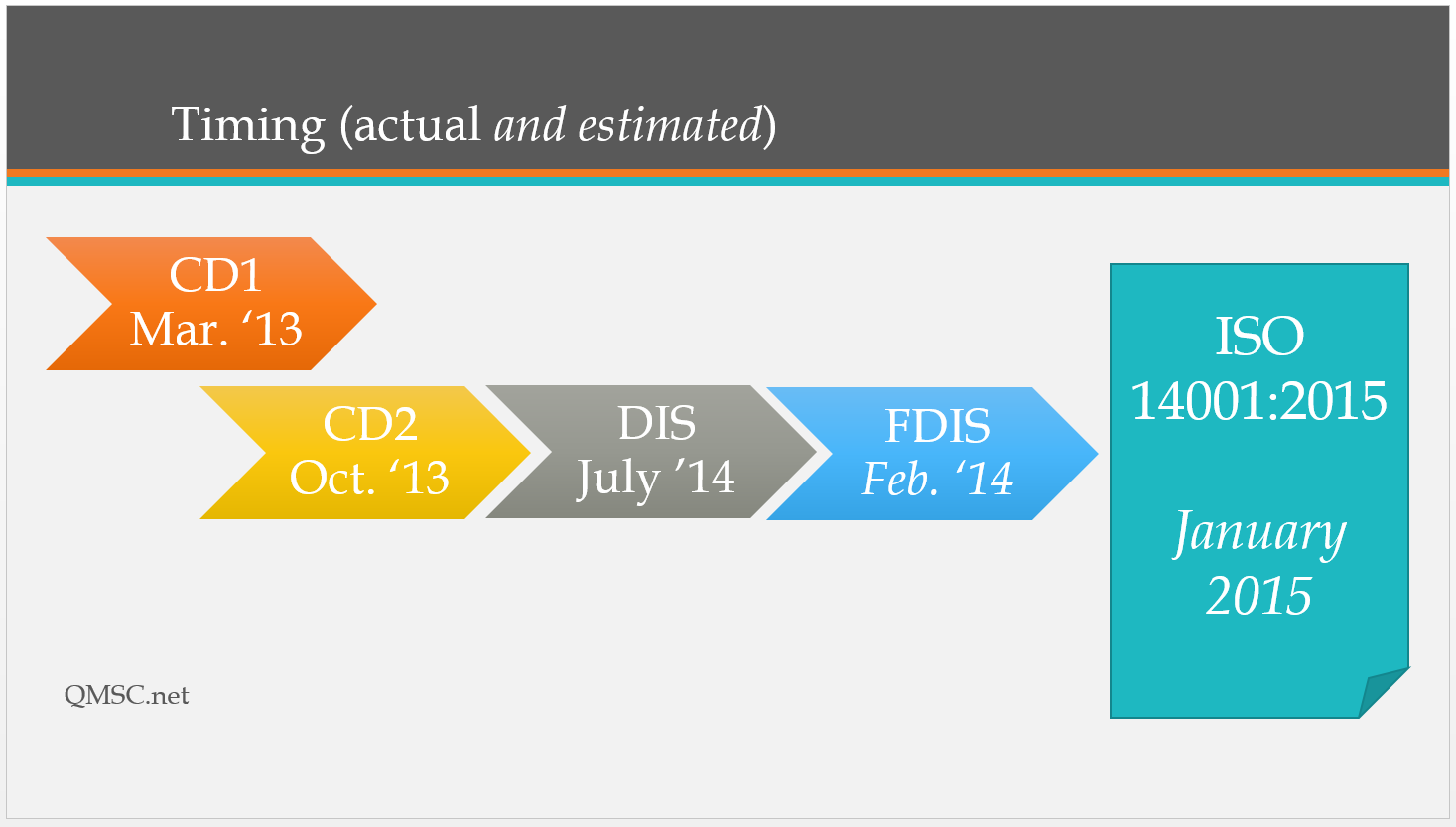 As you may notice, the Final Draft International Standard – FDIS was due originally at the beginning of this year. Didn’t happen.
So, I don’t think it’s likely that the actual release of ISO 14001:2015 will occur in January. I’m thinking September, 2015. Then, as with other standards roll-outs, there will be a transition period of up to sixteen months or so, while existing Certifications move to the new standard at their Surveillance and reCertification audits.
New Certifications typically have a timeframe where the client has a choice in revisions, depending on where they started their process.
Table of contents section of DIS 14001
First thing you’ll notice – the Contents section – huge. HUGE I tell ya. Where the now familiar 2004 has thirteen humble lines, the DIS has, oh… two pages of lines. Audacity.
And it is clearly compliant with Annex SL. Don’t know what that is? We’ve got two great posts with details – here – and here.
Those who are familiar with Annex SL will have an easy time understanding new standards’ releases in the coming years. In actuality, most of what is changed in DIS 14001 can be easily grasped if Annex SL is understood.
Again, this is true for most of the upcoming management systems standards; updated and new.
Definitions section of DIS 14001
There are twenty definitions in the 2004 version, versus thirty-three definitions in the DIS. Of the thirty-three, eleven are both specific to 14001 and new or different in the DIS than in the 2004 version. So, using the power of maths, about two-thirds of the Definitions are built right into the structure of DIS 14001 – courtesy of Annex SL.
Because Annex SL is the new structure for multiple standards, I won’t review what is defined there. If it isn’t in 2004 but is in the DIS I will list it below – with three exceptions.
Same word, different definitions

These are terms defined one way in the 2004 version, and another in DIS 14001. Nothing as blatant as say, the word “Hello” – which was once a exclamation of surprise (thank you, Thomas Edison. See, he wasn’t so bad), or “Manage” which once meant, literally, “the age at which one became a man” (thankfully Sheryl Sandberg never read a vintage dictionary).
But I digress… the differences are subtle, but important because they do illustrate a shift in focus. A focus toward identifying [Annex SL] risks, for one.
environmental aspect
Discussion: DIS 14001 adds “or can interact”. This implies – again – a consideration of risks and the first note does this as well. That second new note, likely closes a loophole present in the current version by forcing the organization to have a rationale for decision making. Here is the text for your own comparison. I’ll use this “Discussion – DIS 14001 – 2004” format for the other definitions, too.
DIS 14001
3.9 – element of an organization’s activities or products or services that interacts or can interact with the environment
Note 1 to entry: An environmental aspect can cause (an) environmental impact(s). A significant environmental aspect is one that has or can have a significant environmental impact.
Note 2 to entry: Significant environmental aspects are determined by the organization applying one or more criteria.
2004
3.6 – element of an organization’s activities or products or services that can interact with the environment
NOTE A significant environmental aspect has or can have a significant environmental impact.
environmental management system
Discussion: The reference to policy is removed in DIS 14001, and risk is integrated along with threats and opportunities. The management of environmental aspects remains the same. The full text of both is below.
DIS 14001
3.4 – part of the management system used to manage environmental aspects, conform to compliance obligations, and address risk associated with threats and opportunities
2004
3.8 – EMS – part of an organization’s management system used to develop and implement its environmental policy and manage its environmental aspects
environmental objective
Discussion: I’m going to miss, “sets itself to achieve” it was almost English.
DIS 14001
3.17 – objective set by the organization consistent with the environmental policy
2004
3.9 – overall environmental goal, consistent with the environmental policy, that an organization sets itself to achieve
environmental performance
Discussion: Some quibbling about what “performance” is here; DIS 14001 translating it to “measurable results”. The rest is very similar, adding “environmental targets” – do not miss the “and” that replaces the “or”; I believe this closes a loophole of sorts.
DIS 14001
3.13 – performance related to the management of environmental aspects
Note 1 to entry: In the context of environmental management systems, results can be measured against the organization’s environmental policy, environmental objectives or other criterion, using indicators.
2004
3.10 – measurable results of an organization’s management of its environmental aspects
NOTE In the context of environmental management systems, results can be measured against the organization’s environmental policy, environmental objectives, environmental targets and other environmental performance requirements.
Nonconformity
DIS 14001
While the definition remains the same between the 2004 version and the DIS (and Annex SL), there is an added:
Note 1 to entry: Nonconformity relates to compliance obligations, including requirements in this International Standard and additional environmental management system requirements that an organization establishes for itself.
Until next time
I’ve covered what Definitions have changed between the two versions, next post I’ll review the new terms.
A copy of your very own DIS 14001 can be purchased – here at ISO.org (I feel sheepishly obliged to tell you I’m not financially connected to them).
Thanks for stopping by!
Sal
P.S. While this is my own independent blog, I would be remiss if I did not point out that if your company is in fact starting down the path to Certification, regardless of the standard, and are in need of a Registrar – I happen to know a great organization that does that kind of thing: Start here at TUV USA (part of TUV Nord).
Mention my name, please – so they’ll think I’ve been up to something useful in my spare time.