All posts by Sal

30 years in the Quality field including experience as QA Manager for a Fortune 100 company and as a Quality System Certification auditor for the top Registrars in the field - plus over 10 years of Information Technology Management in dual roles. Specialties:ISO 9001 Quality, ISO 14001 Environmental, OHSAS 18001 Safety, ISO/IEC 27001 Information Security, RAB QSA Certified Assessor,

Tablet Guide – Auditor Gadgets

Auditor Gadgets - Tablets
Auditor Gadgets – Tablet

We’re starting at the top of the portable gadget food chain with tablet computers. Mostly, we’ll be covering convertible ultrabook tablets.

I’m away enough on the road that any little problem is worth solving – inefficiencies and lost opportunities add up. And when something works – or doesn’t work – I’m more than happy to pass it on.

This is the first in a series of Auditor Gadgets – feel free to pipe in a suggestion or two and I’ll check it out!

Why a Tablet?

Using a tablet means not a single sheet of paper is sullied. Everything I need, whether I write on it, or a customer does – is written directly onto the tablet with a Digitizer Pen.

Back in the day,  when I wasn’t knapping obsidian arrowheads, I printed everything on paper (we called it “papyrus”). All the myriad forms and each page of each checklist needed printing,  then each sheaf had to be laboriously carried – uphill – to the job site. Then we’d gather signatures or otherwise draw (using various pigments) onto the paper. Then the scanning would begin – and never seem to end.

IT’S SO MUCH EASIER NOW. I just create the documents, complete them in digital ink right on the screen – and print to pdf. DONE.

I’ve had my particular tablet for a bit over a year, and while I still really love it – if I had to replace it today, I might choose something else…  I’ll share my reasoning.

The Contenders

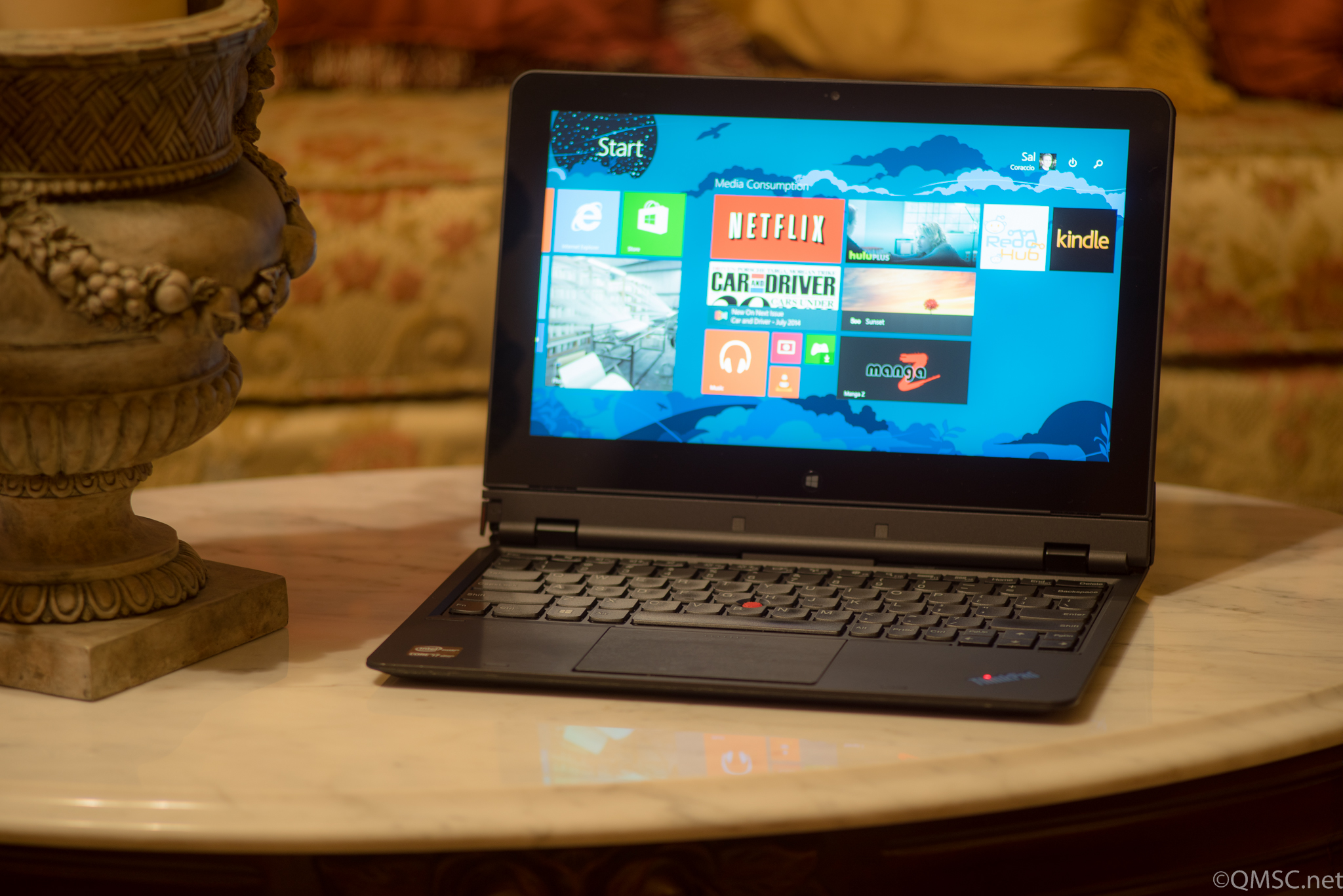
Lenovo ThinkPad Helix Convertible Tablet

First up for your consideration is the Lenovo Thinkpad Helix. Mine is configured as an i7 – they can be had as a slightly less powerful i5 (which most will find completely awesome), and the less expensive i3 is fine if you’re on a budget.

Storage and memory have various combinations as well. I’ve installed 12 gigs of RAM and there’s a 180GB Solid State Drive (SSD). Things run speedily and fairly quietly – occasionally the fans do kick in and the decibels creep up.

The coolest thing about this Windows 8 machine is it is also a tablet with a Digitizer Pen. The screen pops off and I can write on it just like papyrus! For my QMS work it is about as perfect a solution as possible.

What it means is that I can be on a manufacturing floor writing my audit notes; using checklists, referencing standards, taking images of evidence (when allowed), and searching for pertinent information on the internet.

The screen can also be attached facing away from the keyboard. That keyboard houses another battery, by the way, giving the whole rig about 8 hours total.

While I think the intent of that screen flip-ability was that it would be handy for a presentation to a small audience, I find it useful for watching movies on aeroplanes. Because the screen is on the near side of the traytable, it solves the problem of when the person in the row in front of you slams the seat back… I still really hate that person (don’t be that person!)

Other Tablet Options

Lenovo ThinkPad Yoga Tablet

While I do love the Helix, there is now the Lenovo ThinkPad S1 Yoga.

At first there was only the “regular” Yoga – it had touch, but it didn’t use a Digitizer Pen. This version, recently released – does. And it’s hugely important that whatever you get uses a Digitizer Pen – did I mention that? “Touch” does not equal “Digitizer Pen” – the pen has to come with whatever tablet you choose.

It is also an i7, has a larger SSD as well as a slightly larger screen. It doesn’t come apart like mine, but it folds in a way that is nearly as good (or better if you don’t like leaving half of your machine behind).

Battery life is about the same at 7-hours. And it’s a bit cheaper; couple hundred bucks cheaper, actually (don’t ask me what I paid for my Helix when it was new – the week it came out).

Downsides? It’s going to be slightly heavier – but 3.5 pounds isn’t terrible (the Helix is also 3.5 pounds, but it splits in two).

The Microsoft Surface(s)

So, there are now three MS Surfaces that will work quite well; the Surface 2 or Surface Pro 2, and the recently unveiled, Surface Pro 3.

The Surface Pro 2

I have a few colleagues that use the earlier Surfaces – and they do a fine job. I think, though, the one that will really do the task is the Surface Pro 3.

The price on the Surface 2 (not the Pro 2 or Pro 3) is well under $1,000 USD though it is running the lesser version of Windows. The Surface Pro 2 is pricier but also more capable for this task.

Surface Pro 3

The Surface Pro 3 has some pretty impressive specs, and the reviews have all been positive, but I haven’t tried one.

12 inch screen, 8GB RAM, 256GB SSD and a fast processor. And it’s light, under two pounds.

If you do go looking for a Surface , be aware that they don’t normally come with a keyboard/cover – and you’re going to need one.

The Surfaces are built like tanks and definitely have the horsepower. I personally find the screens of all but the Surface Pro 3 a bit small at just under 10 inches. This can be mostly compensated for, however, by adjusting the display settings.

Sony VAIO SVD13223CXB Slider Tablet

The jauntily-named Sony VAIO SVD13223CXB 13.3-Inch Convertible 2 in 1 Touchscreen Ultrabook is a solid and interesting looking machine. The hinge in particular is an engineering marvel as it allows the tablet to slide down and over the keyboard.

An Auditor Gadget Tablet
The Sony VAIO SVD13223CXB

A good-sized screen at a shade over 13 inches, though it is an i5 with somewhat lesser specs overall. I still like it and it will most likely do the job with very capable style as most Sony things do.

The price reflects the configuration, but it really isn’t that much less than the Yoga. It’s a bit on the heavy side, too, at 5 pounds. I wouldn’t get too hung up on even that weight as it cradles comfortably along the forearm.

It could be a great choice if you really love Sony gear (I kinda do since I have significantly more money invested in Sony-labeled things than in anything else).

ASUS Vivo Tab Note 8 Tablet

I thought I’d put this one out there – it’s a bit of a curve-ball. This ASUS Vivo Tab is an 8-inch Windows tablet – without a separate keyboard.  I really like as an option, particularly if you’re only occasionally going out onto a production floor.

An Auditor Gadget Tablet Option
The ASUS Vivo Tab Note 8

It’s quite inexpensive at about a grand less than any other option and the specs reflect that fact. It could easily be paired with a bluetooth keyboard.

Does it run Windows? Yes. Does it use a Digitizer Pen? Yep. Will it be a good tool for the Registrar Auditor? Eh, probably?

Is it as cool as Luke’s mechanical hand and do I want one anyway? Definitely yes (but i’m not giving up my Nexus 7 Tablet).

What Else?

A few of you may be asking, “What about an iPad?”

  • No real digitizer pen – showstopper
  • While it does touch, and has a pointer, it lacks resolution for small writing (yes, I’ve seen it do large pretty signatures in restaurants).
  • No easy way to collect notes – Microsoft OneNote on a Windows tablet is perfect for this. Yes –  there is a OneNote IOS App but it is crippled. “But there’s this cool note-taking app that works with a finger or this nifty pointer!” – No. It forces you to make bite-sized snippets of notes that have to be resized and task-switched and meanwhile you wake up and you’ve grown a long beard and everyone you know has moved on. A long beard made of papyrus.

The iPad is a nice, sexy device – I want one just to look at it and hold it… BUT IT CAN’T DO THIS TASK.

Let me be clear, I have colleagues that love them some iPad, because it does so many things so well – and they are gadget freaks too – but even they can’t make the thing do what it needs to do.

The main problem isn’t the pen/pointer, or the lack of one – it’s a limitation of the screen. Hard to work around that.

Maybe someone could ease the pain with software; a nice app that bypasses the need for detailed writing. A logical collection of related standard selections. But why?? It just isn’t worth the trouble.

Note-taking on a Windows tablet with OneNote – it just works.

Keep your iPad for everything else if you’re a fan, but get a Windows-based tablet with a Digitizer Pen for doing audits.

QMSC’s Top Pick

Because of the flexible form factor and no-compromise workability I have to go with the Lenovo ThinkPad Helix.

It looks perfect on paper and since I’ve used it for over a year I know firsthand how rugged and powerful it is.

The Yoga is probably my second choice, but I’d like to see what the Surface Pro 3’s are all about (I’m a bit afraid they will be the best solution out there but be too pricey for it).

And, I’m kind of feeling like there’s room in my world for an 8 inch Windows Tablet like the Asus Vivo. Nokia makes a similar machine (Nokia Lumia 2520) but it lacks a pen and requires a cell plan.

There you go – the Helix plus a few other good options for an Auditor-friendly tablet computer that will make the Gadget Geek inside you say, “Thank you, kind sir, that was a reasonable list of solutions that I find technically and aesthetically satisfying.” (Gadget Geek is kind of nerdy sometimes).

Do you have a gadget you’re in love with? Post it and share the wealth! There’s always room for more stuff!

Thanks again – and if you do decide to buy something I’ve reviewed here, please do use the links supplied as it will help the site stay around.

Annex SL’s Impact

What does Annex SL have to do with an interesting table leg?
Some supports are interesting

While it might have been the intent that Annex SL would be the template for all new standards and revisions to standards – this isn’t exactly the reality.

Annex SL was described in the last post – you may review that HERE if you like.

As a quick summary, “Annex SL” is an ISO document that defines a framework – the basic structure with common terms and requirements – for a generic management system. A standard would be this structure PLUS any additional sector specific requirements.

Understanding this is the key to new ISO releases, such as DIS ISO 9001:2015.

ISO 9001:2015 will not be the first ISO management standard to employ Annex SL – nor will it be the last.

Already released and compliant with Annex SL:

  • ISO/IEC 27001, Information technology: Security techniques, Information security management systems
  • ISO 30301:2011, Information and documentation: Management systems for records
  • ISO 22301:2012, Societal security: Business continuity management systems
  • ISO 21101:2014, Adventure Tourism
  • ISO 20121:2012, Event sustainability management systems
  • ISO 39001, Road-traffic safety (RTS) management systems
  • ISO 55001, Asset management – Currently on CD ballot with publication scheduled for 2014.

What this means is, for one thing, organizations that have one management system in place will have the basic structure needed to adopt another one – or several.

En route via Annex SL:

  • ISO 9001:2015 (General Quality Management) – I’m guessing you knew that one
  • ISO 14001:2015  (Environmental management) – Also expected in 2015.  I have been following the development of this standard and you’ll find related articles on the site
  • ISO 13485 (Medical devices. Quality management systems. Requirements for regulatory purposes) – Released as a Draft International Standard (DIS) on 20 Feb 2014.  The voting period for that closes on 20 July of this year.

Probable Defections to Annex SL:

These standards, for various political and structural issues I can’t pretend to understand, probably will not utilize Annex SL as their template in the coming updates:

  • ISO/TS 16949 – International Automotive Task Force standard. Cars – the big automotive companies dictate what takes place in this rarefied playing field
  • AS9100/10/20 – International Aerospace Quality Group (IAQG) standards  –  Essentially these folks are the Vegans of the management system world . If you don’t know what I mean by that then I am sorry. Actually, I am also sorry either way
  • ISO 45001 (formerly OHAS 18001) – Occupational Health and Safety. A bit of a controversial one to end on because the ultimate format isn’t set in stone. There are those who believe complying with the Annex SL structure will add too much “bloat” to the document.  Apparently bloat is a bad thing.

That’s approximately the current Annex SL situation, with a few less notable omissions.

Personally, I’m hoping the structure holds firm and far as it should serve to make it easier for clients to adopt – and for auditors and certification bodies to consistently understand.

Can it be better? Probably – but it’s a start, and more importantly – a basis for common ground.

Thanks for checking in – and for calibrating yourself.

And now a word from our sponsor:

Annex SL Esplained

“Annex SL” is an ISO/IEC document that defines a framework for a generic management system. Understanding it is the key to new ISO releases, such as DIS ISO 9001:2015.

It was published by ISO’s Technical Management Board (TMB) in 2012 but since the recent release of DIS ISO 9001:2015 – and it’s strong impact on that standard, a review of the Annex should be helpful to implementors and auditors alike for several years to come.

annex sl page

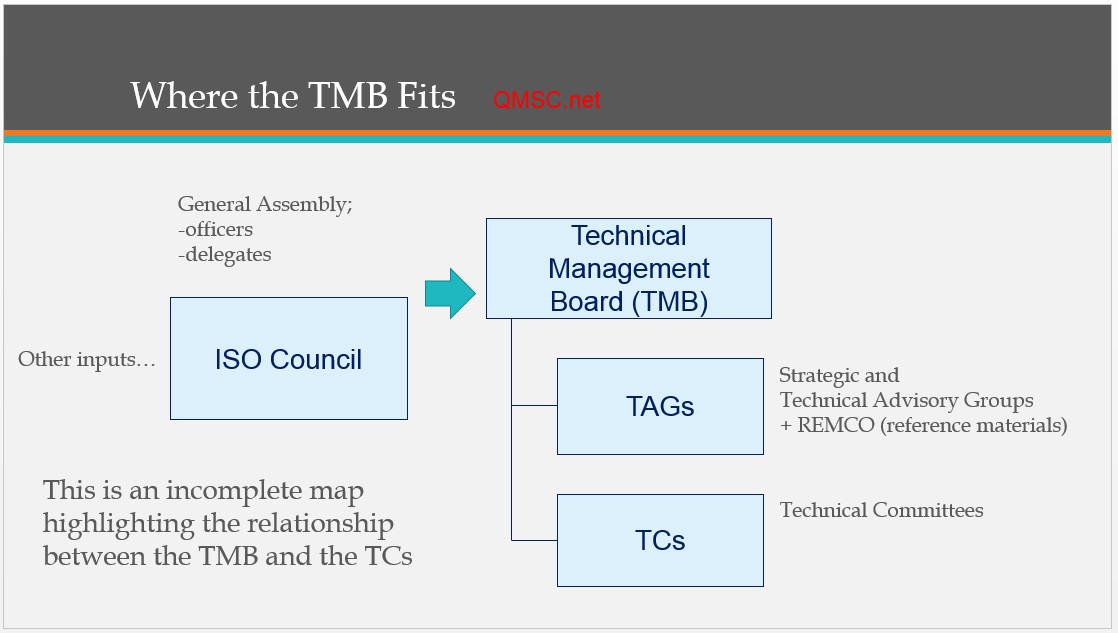
You may not have heard of the TMB – but maybe you have heard of a TC, or “Technical Committee”. These are groups of experts; representatives of industry, NGOs, governments and other stakeholders within ISO. One well-known TC is TC 176 – that’s the group responsible for ISO 9001 or “Quality management and quality assurance”.

There are (or have been) at least 290 TCs (I know this because they are numbered sequentially and the latest one is TC 290).

You can see a full list HERE.

The TMB sits above the TCs within the “Organization” (ISO). Their charter is this that they

  • “… shall have responsibility for the general management of the technical committee structure…
  • approve the establishment and dissolution of technical committees, and revisions of the directives for the work of technical committees…
  • shall deal with all matters of strategic planning, coordination,
  • and monitoring of technical committee activities

– (Article 9.3 of the ISO statutes).

TMB Map

Annex SL is one attempt by the TMB to help the TCs provide a better product more easily and efficiently.

Annex SL does this by:

  1. reducing duplication efforts – many management system standards have the same basic requirements
  2. by reducing the differing interpretation of the same terms, or consolidating terms
  3. and by delivering the material in a clear and repeatable manner; making it digestible by consumers of multiple standards.

As you could imagine, all of these committees don’t always have knowledge of what the others are doing – inconsistencies occur. Then, once a standard is released, the industry; those who are certified to these standards and the auditors that interpret them – sometimes come to different conclusions.

There are mechanisms within the certification process to minimize confusion and disconnects, but a better way is a top-down approach; one that begins above the standards creation level itself. Annex SL is a large leap toward a more effective process.

What is in Annex SL?

It is a template – a framework. Scaffolding for other standards. It consists of:

  • Eight clauses
  • Core text
  • A baseline of 45 ‘shall’ statements generating 84 requirements (differing standards will have additional requirements)
  • Base terms and core definitions

This common structure will contain, in addition, the special requirements of the target standard (forgive, please, my space-saving abbreviations. Click to embiggen, then hit your browser’s back button):

ASL Main Structure

And there are common core definitions; the following words will have the same interpretations across all Annex SL conformant standards:

  • organization
  • interested party (preferred term)
  • stakeholder (admitted term)
  • requirement
  • management system
  • top management
  • effectiveness
  • policy
  • objective
  • risk
  • competence
  • documented information
  • process
  • performance
  • outsource (verb)
  • monitoring
  • measurement
  • audit
  • conformity
  • nonconformity
  • correction
  • corrective action
  • continual improvement

A given standard may have other words to be defined, naturally.

“SL”? – What Does It Stand For?

I wish it was something cooler, but…

“SL” is simply the sequential number of an Annex within numerous annexes as part of a document titled, ISO / IEC Directives, Part 1 “Consolidated ISO Supplement – Procedures specific to ISO”

The Annex before it is “SK” (though it is currently just a placeholder), and the one after it is “SM”, “Global relevance of ISO technical work and publications”.

Aren’t you glad you asked. You were going to ask, right?

For next time:

How has Annex SL impacted Publications?


Thank you again. Go forth – and annex something.