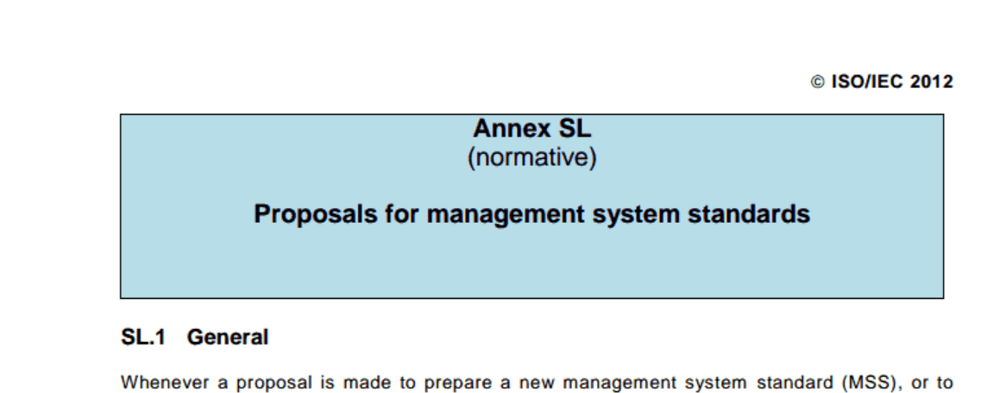
“Annex SL” is an ISO/IEC document that defines a framework for a generic management system. Understanding it is the key to new ISO releases, such as DIS ISO 9001:2015.
It was published by ISO’s Technical Management Board (TMB) in 2012 but since the recent release of DIS ISO 9001:2015 – and it’s strong impact on that standard, a review of the Annex should be helpful to implementors and auditors alike for several years to come.
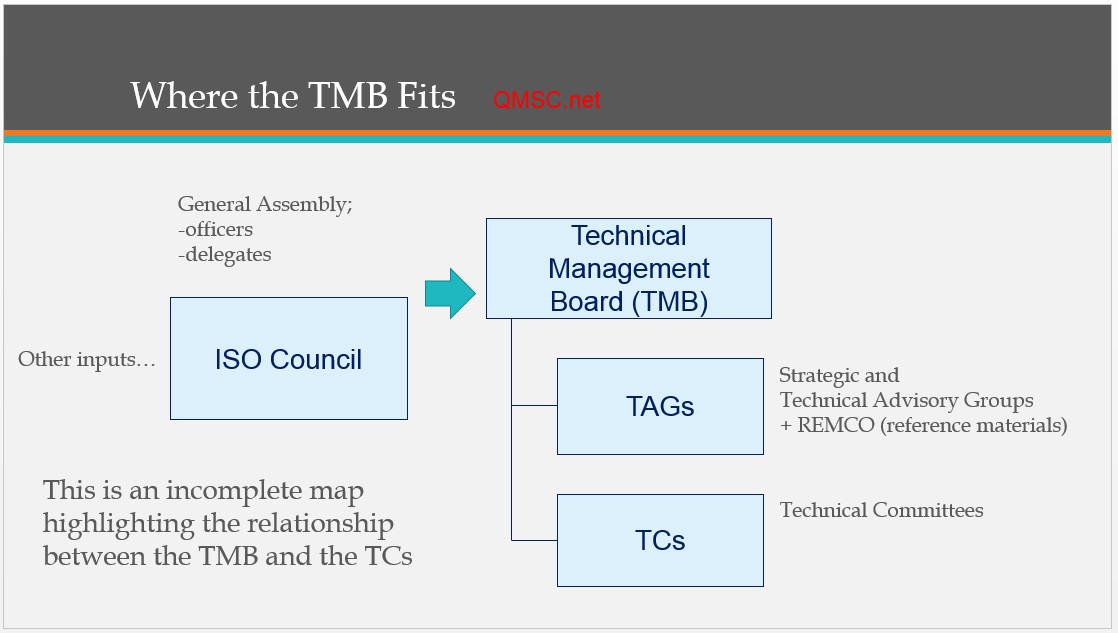
You may not have heard of the TMB – but maybe you have heard of a TC, or “Technical Committee”. These are groups of experts; representatives of industry, NGOs, governments and other stakeholders within ISO. One well-known TC is TC 176 – that’s the group responsible for ISO 9001 or “Quality management and quality assurance”.
There are (or have been) at least 290 TCs (I know this because they are numbered sequentially and the latest one is TC 290).
You can see a full list HERE.
The TMB sits above the TCs within the “Organization” (ISO). Their charter is this that they
- “… shall have responsibility for the general management of the technical committee structure…
- approve the establishment and dissolution of technical committees, and revisions of the directives for the work of technical committees…
- shall deal with all matters of strategic planning, coordination,
- and monitoring of technical committee activities“
– (Article 9.3 of the ISO statutes).
Annex SL is one attempt by the TMB to help the TCs provide a better product more easily and efficiently.
Annex SL does this by:
- reducing duplication efforts – many management system standards have the same basic requirements
- by reducing the differing interpretation of the same terms, or consolidating terms
- and by delivering the material in a clear and repeatable manner; making it digestible by consumers of multiple standards.
As you could imagine, all of these committees don’t always have knowledge of what the others are doing – inconsistencies occur. Then, once a standard is released, the industry; those who are certified to these standards and the auditors that interpret them – sometimes come to different conclusions.
There are mechanisms within the certification process to minimize confusion and disconnects, but a better way is a top-down approach; one that begins above the standards creation level itself. Annex SL is a large leap toward a more effective process.
What is in Annex SL?
It is a template – a framework. Scaffolding for other standards. It consists of:
- Eight clauses
- Core text
- A baseline of 45 ‘shall’ statements generating 84 requirements (differing standards will have additional requirements)
- Base terms and core definitions
This common structure will contain, in addition, the special requirements of the target standard (forgive, please, my space-saving abbreviations. Click to embiggen, then hit your browser’s back button):

And there are common core definitions; the following words will have the same interpretations across all Annex SL conformant standards:
- organization
- interested party (preferred term)
- stakeholder (admitted term)
- requirement
- management system
- top management
- effectiveness
- policy
- objective
- risk
- competence
- documented information
- process
- performance
- outsource (verb)
- monitoring
- measurement
- audit
- conformity
- nonconformity
- correction
- corrective action
- continual improvement
A given standard may have other words to be defined, naturally.
“SL”? – What Does It Stand For?
I wish it was something cooler, but…
“SL” is simply the sequential number of an Annex within numerous annexes as part of a document titled, ISO / IEC Directives, Part 1 “Consolidated ISO Supplement – Procedures specific to ISO”
The Annex before it is “SK” (though it is currently just a placeholder), and the one after it is “SM”, “Global relevance of ISO technical work and publications”.
Aren’t you glad you asked. You were going to ask, right?
For next time:
How has Annex SL impacted Publications?
Thank you again. Go forth – and annex something.
