Category Archives: Audit Preparation

Tablet Guide – Auditor Gadgets

Auditor Gadgets - Tablets
Auditor Gadgets – Tablet

We’re starting at the top of the portable gadget food chain with tablet computers. Mostly, we’ll be covering convertible ultrabook tablets.

I’m away enough on the road that any little problem is worth solving – inefficiencies and lost opportunities add up. And when something works – or doesn’t work – I’m more than happy to pass it on.

This is the first in a series of Auditor Gadgets – feel free to pipe in a suggestion or two and I’ll check it out!

Why a Tablet?

Using a tablet means not a single sheet of paper is sullied. Everything I need, whether I write on it, or a customer does – is written directly onto the tablet with a Digitizer Pen.

Back in the day,  when I wasn’t knapping obsidian arrowheads, I printed everything on paper (we called it “papyrus”). All the myriad forms and each page of each checklist needed printing,  then each sheaf had to be laboriously carried – uphill – to the job site. Then we’d gather signatures or otherwise draw (using various pigments) onto the paper. Then the scanning would begin – and never seem to end.

IT’S SO MUCH EASIER NOW. I just create the documents, complete them in digital ink right on the screen – and print to pdf. DONE.

I’ve had my particular tablet for a bit over a year, and while I still really love it – if I had to replace it today, I might choose something else…  I’ll share my reasoning.

The Contenders

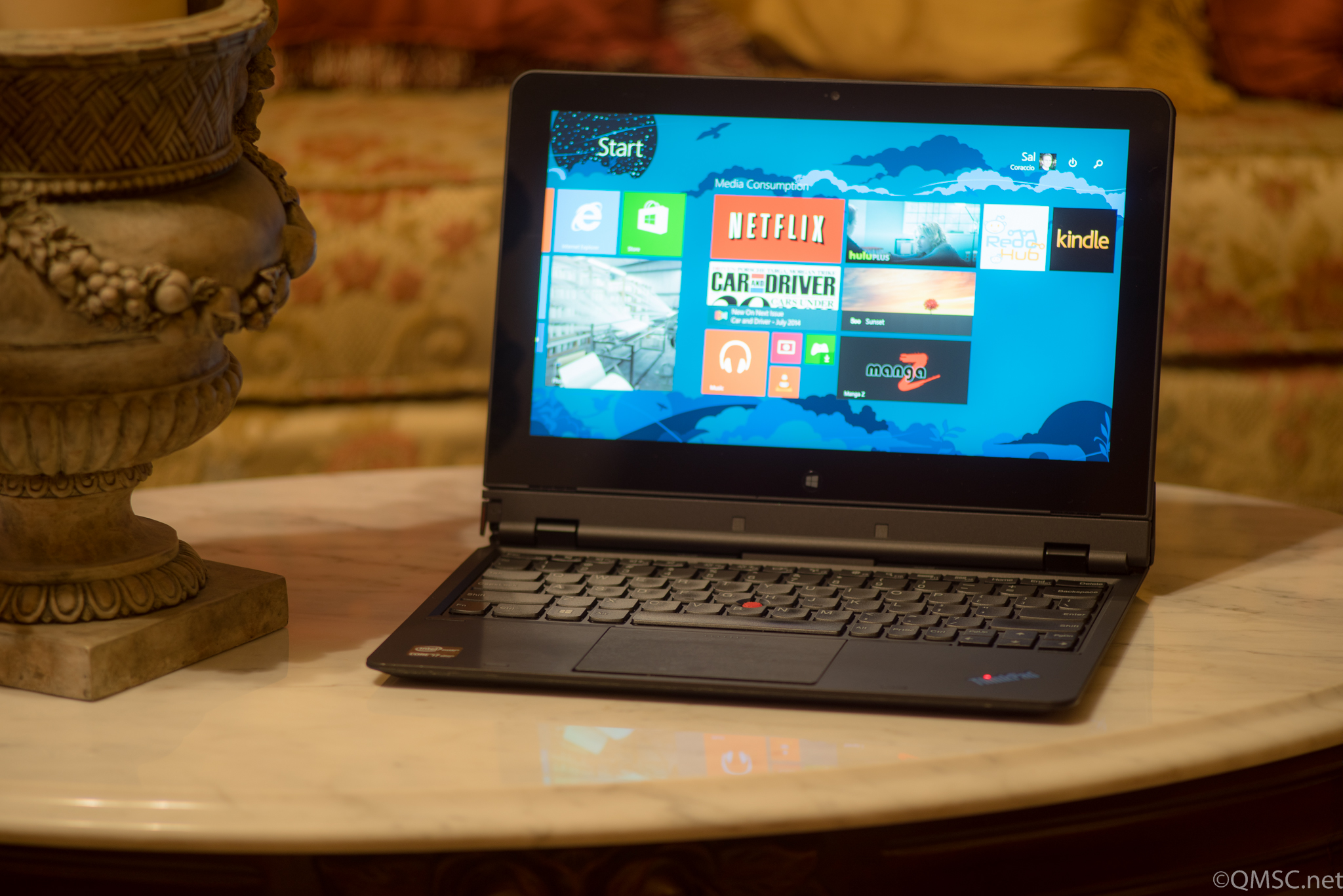
Lenovo ThinkPad Helix Convertible Tablet

First up for your consideration is the Lenovo Thinkpad Helix. Mine is configured as an i7 – they can be had as a slightly less powerful i5 (which most will find completely awesome), and the less expensive i3 is fine if you’re on a budget.

Storage and memory have various combinations as well. I’ve installed 12 gigs of RAM and there’s a 180GB Solid State Drive (SSD). Things run speedily and fairly quietly – occasionally the fans do kick in and the decibels creep up.

The coolest thing about this Windows 8 machine is it is also a tablet with a Digitizer Pen. The screen pops off and I can write on it just like papyrus! For my QMS work it is about as perfect a solution as possible.

What it means is that I can be on a manufacturing floor writing my audit notes; using checklists, referencing standards, taking images of evidence (when allowed), and searching for pertinent information on the internet.

The screen can also be attached facing away from the keyboard. That keyboard houses another battery, by the way, giving the whole rig about 8 hours total.

While I think the intent of that screen flip-ability was that it would be handy for a presentation to a small audience, I find it useful for watching movies on aeroplanes. Because the screen is on the near side of the traytable, it solves the problem of when the person in the row in front of you slams the seat back… I still really hate that person (don’t be that person!)

Other Tablet Options

Lenovo ThinkPad Yoga Tablet

While I do love the Helix, there is now the Lenovo ThinkPad S1 Yoga.

At first there was only the “regular” Yoga – it had touch, but it didn’t use a Digitizer Pen. This version, recently released – does. And it’s hugely important that whatever you get uses a Digitizer Pen – did I mention that? “Touch” does not equal “Digitizer Pen” – the pen has to come with whatever tablet you choose.

It is also an i7, has a larger SSD as well as a slightly larger screen. It doesn’t come apart like mine, but it folds in a way that is nearly as good (or better if you don’t like leaving half of your machine behind).

Battery life is about the same at 7-hours. And it’s a bit cheaper; couple hundred bucks cheaper, actually (don’t ask me what I paid for my Helix when it was new – the week it came out).

Downsides? It’s going to be slightly heavier – but 3.5 pounds isn’t terrible (the Helix is also 3.5 pounds, but it splits in two).

The Microsoft Surface(s)

So, there are now three MS Surfaces that will work quite well; the Surface 2 or Surface Pro 2, and the recently unveiled, Surface Pro 3.

The Surface Pro 2

I have a few colleagues that use the earlier Surfaces – and they do a fine job. I think, though, the one that will really do the task is the Surface Pro 3.

The price on the Surface 2 (not the Pro 2 or Pro 3) is well under $1,000 USD though it is running the lesser version of Windows. The Surface Pro 2 is pricier but also more capable for this task.

Surface Pro 3

The Surface Pro 3 has some pretty impressive specs, and the reviews have all been positive, but I haven’t tried one.

12 inch screen, 8GB RAM, 256GB SSD and a fast processor. And it’s light, under two pounds.

If you do go looking for a Surface , be aware that they don’t normally come with a keyboard/cover – and you’re going to need one.

The Surfaces are built like tanks and definitely have the horsepower. I personally find the screens of all but the Surface Pro 3 a bit small at just under 10 inches. This can be mostly compensated for, however, by adjusting the display settings.

Sony VAIO SVD13223CXB Slider Tablet

The jauntily-named Sony VAIO SVD13223CXB 13.3-Inch Convertible 2 in 1 Touchscreen Ultrabook is a solid and interesting looking machine. The hinge in particular is an engineering marvel as it allows the tablet to slide down and over the keyboard.

An Auditor Gadget Tablet
The Sony VAIO SVD13223CXB

A good-sized screen at a shade over 13 inches, though it is an i5 with somewhat lesser specs overall. I still like it and it will most likely do the job with very capable style as most Sony things do.

The price reflects the configuration, but it really isn’t that much less than the Yoga. It’s a bit on the heavy side, too, at 5 pounds. I wouldn’t get too hung up on even that weight as it cradles comfortably along the forearm.

It could be a great choice if you really love Sony gear (I kinda do since I have significantly more money invested in Sony-labeled things than in anything else).

ASUS Vivo Tab Note 8 Tablet

I thought I’d put this one out there – it’s a bit of a curve-ball. This ASUS Vivo Tab is an 8-inch Windows tablet – without a separate keyboard.  I really like as an option, particularly if you’re only occasionally going out onto a production floor.

An Auditor Gadget Tablet Option
The ASUS Vivo Tab Note 8

It’s quite inexpensive at about a grand less than any other option and the specs reflect that fact. It could easily be paired with a bluetooth keyboard.

Does it run Windows? Yes. Does it use a Digitizer Pen? Yep. Will it be a good tool for the Registrar Auditor? Eh, probably?

Is it as cool as Luke’s mechanical hand and do I want one anyway? Definitely yes (but i’m not giving up my Nexus 7 Tablet).

What Else?

A few of you may be asking, “What about an iPad?”

  • No real digitizer pen – showstopper
  • While it does touch, and has a pointer, it lacks resolution for small writing (yes, I’ve seen it do large pretty signatures in restaurants).
  • No easy way to collect notes – Microsoft OneNote on a Windows tablet is perfect for this. Yes –  there is a OneNote IOS App but it is crippled. “But there’s this cool note-taking app that works with a finger or this nifty pointer!” – No. It forces you to make bite-sized snippets of notes that have to be resized and task-switched and meanwhile you wake up and you’ve grown a long beard and everyone you know has moved on. A long beard made of papyrus.

The iPad is a nice, sexy device – I want one just to look at it and hold it… BUT IT CAN’T DO THIS TASK.

Let me be clear, I have colleagues that love them some iPad, because it does so many things so well – and they are gadget freaks too – but even they can’t make the thing do what it needs to do.

The main problem isn’t the pen/pointer, or the lack of one – it’s a limitation of the screen. Hard to work around that.

Maybe someone could ease the pain with software; a nice app that bypasses the need for detailed writing. A logical collection of related standard selections. But why?? It just isn’t worth the trouble.

Note-taking on a Windows tablet with OneNote – it just works.

Keep your iPad for everything else if you’re a fan, but get a Windows-based tablet with a Digitizer Pen for doing audits.

QMSC’s Top Pick

Because of the flexible form factor and no-compromise workability I have to go with the Lenovo ThinkPad Helix.

It looks perfect on paper and since I’ve used it for over a year I know firsthand how rugged and powerful it is.

The Yoga is probably my second choice, but I’d like to see what the Surface Pro 3’s are all about (I’m a bit afraid they will be the best solution out there but be too pricey for it).

And, I’m kind of feeling like there’s room in my world for an 8 inch Windows Tablet like the Asus Vivo. Nokia makes a similar machine (Nokia Lumia 2520) but it lacks a pen and requires a cell plan.

There you go – the Helix plus a few other good options for an Auditor-friendly tablet computer that will make the Gadget Geek inside you say, “Thank you, kind sir, that was a reasonable list of solutions that I find technically and aesthetically satisfying.” (Gadget Geek is kind of nerdy sometimes).

Do you have a gadget you’re in love with? Post it and share the wealth! There’s always room for more stuff!

Thanks again – and if you do decide to buy something I’ve reviewed here, please do use the links supplied as it will help the site stay around.

Audit Preparation

So, you’ve got an audit coming up – your registrar is sending out someone you know is out to ruin your whole day. I’d like to help save you.

One important key to success is self confidence. An important key to self confidence is preparation
– Arthur Ashe

First off, some context  – what are you preparing for? In order to be Certified (or Registered), at some point there needs to be troops on the ground to evaluate your company against your standard of choice. Sure, they are friendly troops – probably even likable in their doltish, uncomplicated way; but they aren’t your troops, and you’re really not sure what side they’re on.

Fact is that they probably are on your side, and they don’t want to make your life more complicated – or theirs, but you have to meet them at least half-way. The trick is to start off on the right foot by making their job easier. Why not? And let them know you understand they are only there to make the system stronger.

So we’re all on the same page, let’s review the process of getting and staying Registered (or Certified – let’s pretend it’s the same thing, okay?).

The Certification Cycle

There is a sequence of events to getting Registered. Part of it is a continuous loop. Once you’ve gotten your system mostly installed and have a minimal amount of records from it, typically you will begin the path that includes several stages.

Certification Loop - audit preparation

Stage 1” audit: Also known as a “Readiness Review” this is where you want to show the skeletons in the closet; reveal as much as you can. It is more of a “check off the boxes” type of audit; does the piece exist or not? Registrars vary in the depth of auditing on Stage 1’s and generally more is better. Ideally you’ll want a deeper audit, but time is a factor. If you’re confident in an area, best to encourage the auditor to move on. Don’t forget that this is mostly for your benefit (the auditor is using it to get a feel for the territory and help in his planning process). It is a good idea to have your Registrar describe the depth of their version of a Stage 1. Even within a Registrar there is variation between auditors in just how deep they’ll go on a Stage 1 – letting your program manager know you are concerned with depth will help ensure you get what you want.

There will typically be an action list from this exercise – no non-conformances (there may be several dozen; more is better). Use this to help you determine if you are ready for the next stage. Two months is typical, sometimes it means six; depends on the issues and your resources.

The “Stage 2” or Registration/Certification Audit is the actual game time. You’ll want to limit your answers (and the answers of all employees) to what is being asked. Part of this is because time will be relatively tight, and side-trips are exactly that. There will be interviews, paperwork and records reviewed – an audit. They are as fun as they sound. In all actuality they are often quite pleasant, the key is to remember that everyone is really on the same team, and the goal is improvement. It is not unusual to have a small training session so folks know what to expect and how to act.

Action items become non-conformances in two flavors; minors and majors. Definitions vary, but essentially a minor represents a single or a few occurrences or deviations to an established procedure. Majors would be a large numbers of minors in one area, or a missing key process; such as no or shoddy Internal Audits, lack of an effective Management Review, or evidence of bad product escaping to a customer. Majors may require either a submission of documents, or a physical re-audit of the impacted section of the standard.

You can expect, and should not feel sheepish about, a small number of minors. The only real difference between majors and minors is the amount of time allowed to respond and correct them before Certification will be recommended.

Once Recommendation occurs – this, by the way, is the most an Auditor can grant you, the audit package is submitted. Usually there are two levels of post-audit review; an administrative review, and a technical review. Administrative means checking for the correct forms – were all the right things done. Technical review means a more detailed review by someone who knows about auditing and has knowledge of the applicable standard. It is for checking if the right things were done right.

It is seldom that a recommendation is overturned, but not terribly unusual for there to be small clerical errors in need of repair or clarifications needed.

And then – CONGRATULATIONS! You’ve got yourself a Certificate – probably even a framed one (some Registrars actually provide an engraved plaque…)

Then the “Surveillance Audit” cycle begins. Usually it is in one year’s time, though some Registrars allow, and customers request, that these occur twice per year. This will depend on the culture and resources of the company, and typically a twice-annual process works when higher external supervision or validation is desired.

These audits look always at the core clauses; Internal Audits, Management Reviews, Corrective and Preventive Actions, Improvements – along with some portion of the remainder. After another year, there is another Surveillance. This one, again, looks at those core clauses plus whatever was not looked at in the previous audit. There is often overlap regarding manufacturing.

Completing the loop, after two yearly surveillances have occurred, is a “reCertification” audit. This looks at the full system, though with less depth than the original audit and more focus on improvement capabilities.

I’ll close with a short list of what you should have ready for the auditor to look at on your Surveillance audits.

Surveillance Audit Preparation

This list is made specifically for Surveillance audits, but should work well as a start for Certification audits as well. Have available the following documents and records:

Minimum Documents

  1. Quality Manual (1 printed copy for each auditor).
  2. Procedures, if you have them, for:
    • Management review,
    • internal audits,
    • corrective and preventive action and
    • non-conforming product. Ensure they are easily accessible.
  3. These can be either printed, put onto a USB stick for auditor use, or easily accessible via some on-line interface. Allow the auditor time and space to “drive”.
  4. The above is the minimum they’ll need; if you’ve got a binder with all of the procedures then all the better. Also, a master list of all documents is handy – I know this is not a requirement in many cases (unless your dated system has made it one), but if you have one – this would be a good time to have it there for the auditors.

Minimum Records

  1. Last two Management Reviews; the “minutes and materials” with any action items and progress to them if those are not contained in the record.
  2. Internal audit reports and notes, including the full schedule [<- how to make one].
  3. Recent corrective, preventive and improvement actions. Sometimes this is a database, sometimes it is a log with references to completed forms; have them available or a plan for how the auditor may access them.
  4. If Training is on the agenda, having a list of recent hires is useful (past 6 months should be fine).

vs donutsSome other “nice to haves”

  1. Internet access; wired or wireless.
  2. Bottled water and juice (juice boxes … tempting).
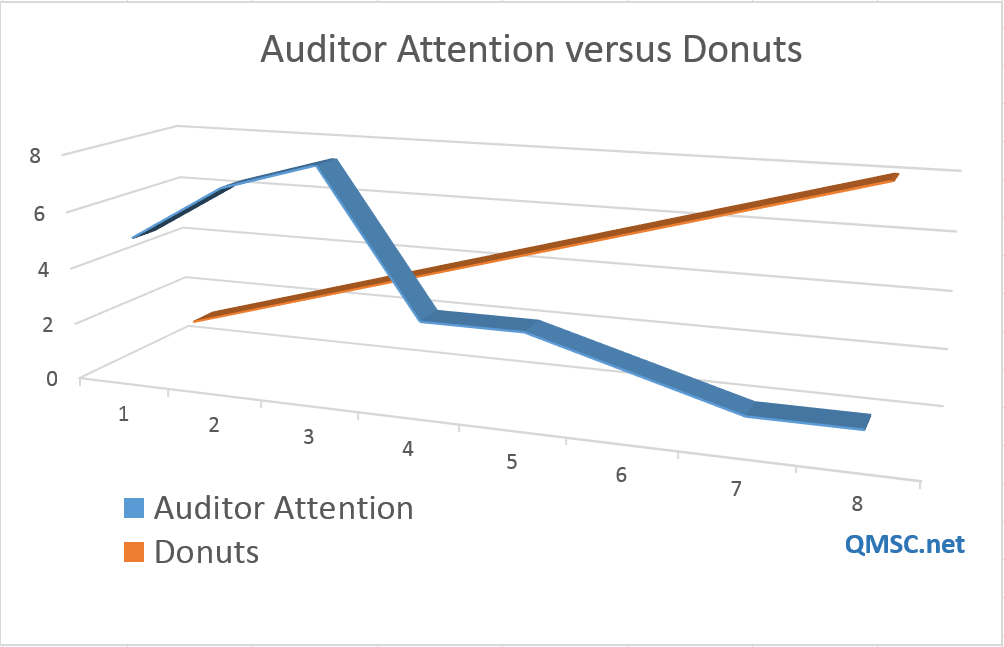
  3. Snacks and the like are completely optional – auditors eat enough junk food on the road. But if you and your crew want an excuse to get bagels or donuts, or bagels and donuts – or muffins, or bagels and donuts and muffins then I’m sure the auditor will be happy to join you. Let’s call coffee and tea (hot water) a given.
  4. A provision for lunch – typically this should be brought-in to save time. A selection of menus is usually good. Please, keep in mind that some of us are vegetarians – and the house salad shouldn’t be the only option. Do you really want a grumpy, hungry auditor?

So there’s a few things you should know as you prepare for an audit. A little background, what to expect, and how you can get off on the right foot with the audit team.

Keep it positive and non-contentious, and you’ll do just fine.


Good luck and, I know you will with pride – go forth, and calibrate thyself.

Thank you,

Sal