So, you’ve got an audit coming up – your registrar is sending out someone you know is out to ruin your whole day. I’d like to help save you.
One important key to success is self confidence. An important key to self confidence is preparation
– Arthur Ashe
First off, some context – what are you preparing for? In order to be Certified (or Registered), at some point there needs to be troops on the ground to evaluate your company against your standard of choice. Sure, they are friendly troops – probably even likable in their doltish, uncomplicated way; but they aren’t your troops, and you’re really not sure what side they’re on.
Fact is that they probably are on your side, and they don’t want to make your life more complicated – or theirs, but you have to meet them at least half-way. The trick is to start off on the right foot by making their job easier. Why not? And let them know you understand they are only there to make the system stronger.
So we’re all on the same page, let’s review the process of getting and staying Registered (or Certified – let’s pretend it’s the same thing, okay?).
The Certification Cycle
There is a sequence of events to getting Registered. Part of it is a continuous loop. Once you’ve gotten your system mostly installed and have a minimal amount of records from it, typically you will begin the path that includes several stages.

“Stage 1” audit: Also known as a “Readiness Review” this is where you want to show the skeletons in the closet; reveal as much as you can. It is more of a “check off the boxes” type of audit; does the piece exist or not? Registrars vary in the depth of auditing on Stage 1’s and generally more is better. Ideally you’ll want a deeper audit, but time is a factor. If you’re confident in an area, best to encourage the auditor to move on. Don’t forget that this is mostly for your benefit (the auditor is using it to get a feel for the territory and help in his planning process). It is a good idea to have your Registrar describe the depth of their version of a Stage 1. Even within a Registrar there is variation between auditors in just how deep they’ll go on a Stage 1 – letting your program manager know you are concerned with depth will help ensure you get what you want.
There will typically be an action list from this exercise – no non-conformances (there may be several dozen; more is better). Use this to help you determine if you are ready for the next stage. Two months is typical, sometimes it means six; depends on the issues and your resources.
The “Stage 2” or Registration/Certification Audit is the actual game time. You’ll want to limit your answers (and the answers of all employees) to what is being asked. Part of this is because time will be relatively tight, and side-trips are exactly that. There will be interviews, paperwork and records reviewed – an audit. They are as fun as they sound. In all actuality they are often quite pleasant, the key is to remember that everyone is really on the same team, and the goal is improvement. It is not unusual to have a small training session so folks know what to expect and how to act.
Action items become non-conformances in two flavors; minors and majors. Definitions vary, but essentially a minor represents a single or a few occurrences or deviations to an established procedure. Majors would be a large numbers of minors in one area, or a missing key process; such as no or shoddy Internal Audits, lack of an effective Management Review, or evidence of bad product escaping to a customer. Majors may require either a submission of documents, or a physical re-audit of the impacted section of the standard.
You can expect, and should not feel sheepish about, a small number of minors. The only real difference between majors and minors is the amount of time allowed to respond and correct them before Certification will be recommended.
Once Recommendation occurs – this, by the way, is the most an Auditor can grant you, the audit package is submitted. Usually there are two levels of post-audit review; an administrative review, and a technical review. Administrative means checking for the correct forms – were all the right things done. Technical review means a more detailed review by someone who knows about auditing and has knowledge of the applicable standard. It is for checking if the right things were done right.
It is seldom that a recommendation is overturned, but not terribly unusual for there to be small clerical errors in need of repair or clarifications needed.
And then – CONGRATULATIONS! You’ve got yourself a Certificate – probably even a framed one (some Registrars actually provide an engraved plaque…)
Then the “Surveillance Audit” cycle begins. Usually it is in one year’s time, though some Registrars allow, and customers request, that these occur twice per year. This will depend on the culture and resources of the company, and typically a twice-annual process works when higher external supervision or validation is desired.
These audits look always at the core clauses; Internal Audits, Management Reviews, Corrective and Preventive Actions, Improvements – along with some portion of the remainder. After another year, there is another Surveillance. This one, again, looks at those core clauses plus whatever was not looked at in the previous audit. There is often overlap regarding manufacturing.
Completing the loop, after two yearly surveillances have occurred, is a “reCertification” audit. This looks at the full system, though with less depth than the original audit and more focus on improvement capabilities.
I’ll close with a short list of what you should have ready for the auditor to look at on your Surveillance audits.
Surveillance Audit Preparation
This list is made specifically for Surveillance audits, but should work well as a start for Certification audits as well. Have available the following documents and records:
Minimum Documents
- Quality Manual (1 printed copy for each auditor).
- Procedures, if you have them, for:
- Management review,
- internal audits,
- corrective and preventive action and
- non-conforming product. Ensure they are easily accessible.
- These can be either printed, put onto a USB stick for auditor use, or easily accessible via some on-line interface. Allow the auditor time and space to “drive”.
- The above is the minimum they’ll need; if you’ve got a binder with all of the procedures then all the better. Also, a master list of all documents is handy – I know this is not a requirement in many cases (unless your dated system has made it one), but if you have one – this would be a good time to have it there for the auditors.
Minimum Records
- Last two Management Reviews; the “minutes and materials” with any action items and progress to them if those are not contained in the record.
- Internal audit reports and notes, including the full schedule [<- how to make one].
- Recent corrective, preventive and improvement actions. Sometimes this is a database, sometimes it is a log with references to completed forms; have them available or a plan for how the auditor may access them.
- If Training is on the agenda, having a list of recent hires is useful (past 6 months should be fine).
 Some other “nice to haves”
- Internet access; wired or wireless.
- Bottled water and juice (juice boxes … tempting).
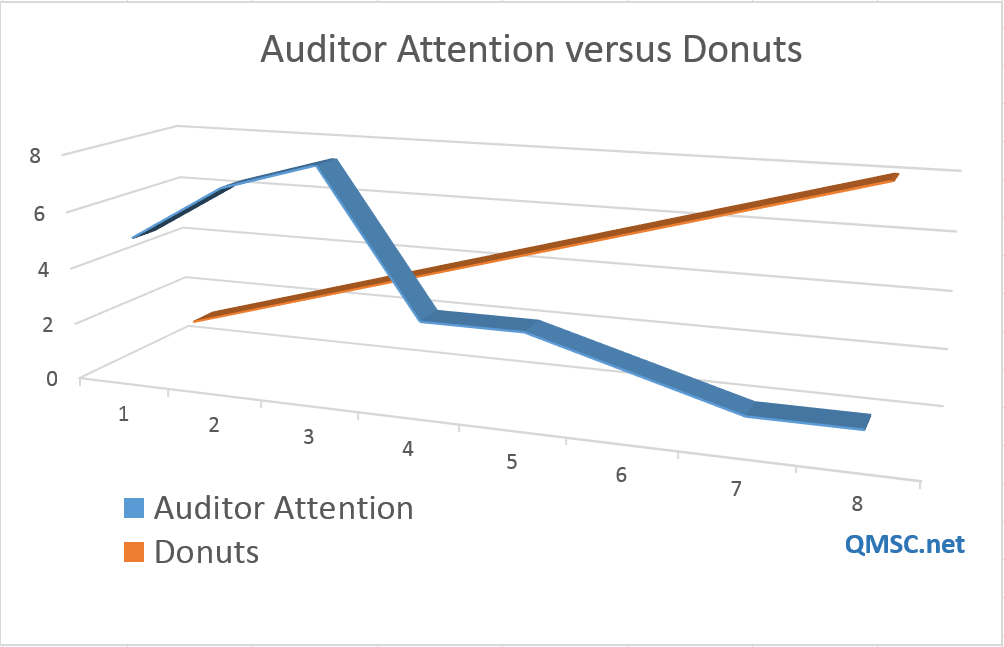
- Snacks and the like are completely optional – auditors eat enough junk food on the road. But if you and your crew want an excuse to get bagels or donuts, or bagels and donuts – or muffins, or bagels and donuts and muffins then I’m sure the auditor will be happy to join you. Let’s call coffee and tea (hot water) a given.
- A provision for lunch – typically this should be brought-in to save time. A selection of menus is usually good. Please, keep in mind that some of us are vegetarians – and the house salad shouldn’t be the only option. Do you really want a grumpy, hungry auditor?
So there’s a few things you should know as you prepare for an audit. A little background, what to expect, and how you can get off on the right foot with the audit team.
Keep it positive and non-contentious, and you’ll do just fine.
Good luck and, I know you will with pride – go forth, and calibrate thyself.
Thank you,