Category Archives: Events

ISOfocus Magazine – Nov-Dec Edition Published

ISOfocus, the magazine published by ISO.org, has just hit the electronic newsstands with its latest edition.
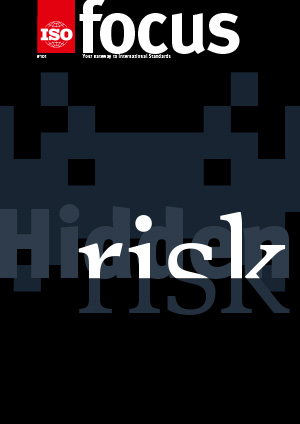
Nov-Dec Issue of ISOfocusIn their words, the magazine “is your gateway to International Standards…”

It comes out six times a year, and the November-December edition holds up to a close look; with fifty pages of articles, sharp images, clever graphics and competent writing.

Here’s the table of contents, with a quick summary of each article:

  • Social feed – one page summary of all things related to ISO’s social networking; Facebook, Twitter, Google+, YouTube.
  • The new cyber warfare – results from a recent study on information security breaches are used to highlight the [increasingly scary] problem, while ISO 27001 is presented as part of the solution.
  • Making it –  Quality Assurance Officer at the Kenya Bureau of Standards (KEBS), and the winning author of the ISO/DIN contest for young standardizers in developing countries, Amwayi Omukhweso William shares his story of beating the odds.
  • Clearing the air on cookstoves – a well-made graphic used to illustrate the need behind  the creation of a new ISO technical committee developing standards for eco-friendly appliances.
  • The reason for rail –  An interview with Dr. Yuji Nishie, Chair of the new ISO technical committee on railroad applications, explores how International Standards can contribute to high-speed rail’s safety record and global growth.
  • From Russia with love – The highlights from the recent ISO General Assembly in St. Petersburg, Russia.
  • IT training competes for quality – An IT training company discusses its path to ISO 29990 to make sustained improvements in the quality of its services.
  • A day in the life of Rob Steele – Rob Steele is the Secretary-General of ISO.
  • Bridging the disability divide – Another interesting set of statistics, these used to show how the wide-ranging portfolio of ISO standards on accessibility aims to improve safety and quality of life.
  • From mother to son – “Pedram Honari lost his mother to International Standards at a very early age. It was only when he needed to investigate the field for a research paper at school that Pedram was finally reconciled with the importance of standardization
  • Are you a #standards geek? – Nine signs that you, or your friends, may be standards geeks. I have at least eight of them, and the fact that I can think of several more than nine should grant me a special category.
  • Energy boost for Costa Coffee – A look at how a large coffee company used ISO 50001 to cut energy use and to increase production.

There are also small sections, labeled “Buzz” with interesting tidbits, and an article about the recently awarded “ISO Prize” – these are interspersed between the main articles.

I’m looking forward to giving this issue a closer read on my next flight. Back issues can be found here.

Enjoy your Friday. Go forth, and calibrate thyself already!

Sal
 

ISO Survey Results Released

The most recent ISO survey results were released. It shows a significant rise in Energy Management certificates, along with gains across all standards.

ISO does this every year, as it has done since 1993, to show the number of certificates issued to management system standards in the previous year.

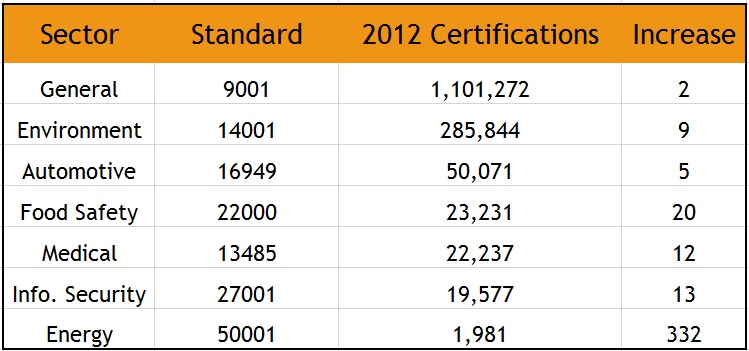
The big increases were found in energy management (ISO 50001) with a 332% increase, and food safety (ISO 22000) coming in at 20% higher between 2011 and 2012.

ISO Study 1

The ISO survey results do only cover certificates by subset of those issued, specifically by IAF accredited certification bodies (registrars). The IAF is essentially an international club of accreditation bodies – this is the layer that audits registrars like TUV, BSi, NSAI, UL – there are more. You are audited by the registrar, the registrar is audited by the accreditation body, or a representative of them.

There is arguably a higher level of credibility with an accredited registrar, and when selecting vendors on the basis of their ISO registration status, it’s a good idea to ensure their certificate is accredited – fodder for another post, however.

I’d like to say that if we were to count the non-IAF certificates, the numbers would likely be higher, which is generally true, but percentage-wise; from one year to the next – who knows. I won’t even mention it then.

The ISO standard for the medical devices field (ISO 13485) and the information security standard (ISO 27001) did quite well, too, both showing about a 12.5% growth.

9001 certifications in 2012, which are by far the most numerous at over 1.1 million worldwide,  show steady growth in the ISO survey, along with the environmental standard (ISO 14001).

Personally, I wasn’t surprised to see the very healthy increase in ISO 27001 certifications, and I think it will continue to do so. The growth in the food safety sector with ISO 22000 is also pretty stunning, especially in light of how recently it has been added to the playing field.

The full report can be found on ISO’s site.

Thanks for reading; go forth – and calibrate thyself.

Sal

Sunday Summary

Here’s a look at the week gone by.

This week’s “Toolsday” brought us a tutorial on how to create a Pareto chart using Excel 2013, which may be helpful to some of you. You’ll find how to create one in other versions of Excel with a little Google-fu, but ours may be the only currently available for the latest version.

That was the extent of the formal posts this week, excepting tweets and Facebook updates. A large part of my week was occupied with a reCertification audit. This is, by the way, what happens after two yearly “surveillance audits” – you may remember we covered the audit cycle in an earlier post.

This company was actually very good – one of the better implementations I’ve seen as a point of fact. Thought I would spend a few moments listing a few bullet points on why this is so.

  • First, it’s a long-time implementation; they started their journey, albeit in a slightly different structural form, in the mid-nineties. That would have been the 1994 version of the standard. So, in a word, Experience.
  • Secondly, they have strong quality system leadership; a competent and vocal Management Representative who enjoys the technical and practical respect of those around him. Call that, summarily, Stewardship. This differs slightly from leadership, which some may call this and they would be still correct, if imprecise – in that a steward also helps operate the machine and knows how it works. It is vitally important that the leadership support the system, and that is truly a component of Stewardship and something at which this particular company also excels.
  • Thirdly, there is little difference between how seriously the formal management system is taken at the different levels of the organization. Soldier and general alike reference and follow the established processes and are actively concerned with improving them. Let’s call this Cultural Integration.

Most companies have some or all of these, and other nice-to-have’s, to varying degrees – but these folks are rock solid, “Best in Show” in each of these three. So, three keys to a successful, world class formal management system implementation: Experience, Stewardship, and Cultural Integration.

Would like also to make mention of another activity from the week, a meeting of the Granite State Quality Council. I’m planning on a dedicated post about the Council, but this event made recognition of two outstanding New Hampshire organizations.

There were presentations on these organizations’ best practices and lessons learned to help audience members improve their own organizations. Part of the night was devoted to recognizing the dedicated Examiners and Judges who participated in the program. It was my first experience with the Granite State Quality Council and I do hope to become more involved.

Looking forward to three audits next week: California, Massachusetts and good ol’ New Hampshire.

And I do hope you have a fulfilling week as well. Get some rest.

Sal