Hey all, I hope your weekend has been woverly and you’re almost re-energized for the week ahead.
But, first here’s a look back at last week’s posts:
Part 3 of the Internal Audit Schedule was on Toolsday – Risk Based Auditing the big finale. We’ll be hearing more about that in the weeks to come.
Wednesday we covered the ISO General Assembly. This year it took place in St. Petersburg, Russia and it ended yesterday, as a matter of fact. I hope to hear some news about the outcome, once the dust has settled.
Thursday I discussed some tips on preparing for an audit, including a little background on the audit process.
And finally, we had a Foto Friday consisting of Sceneries from my audit in Tucson, AZ USA. Took full advantage of my time zone difference and managed a sunrise. The two sunsets, one of which include a 30 minute hike down a 9000 foot mountain in the dark (what could go wrong?) – were more of a challenge.
Pretty full week, all in all. I spent the bulk of it performing a reCertification audit for a fine company near Chicago, IL. Oh! and did a guest appearance on my pal Ernie Blanchard’s “ISO Audit Geek” Podcast on Wednesday. He does a great job and I’m quite sure I’ve ruined that episode for him.
And speaking of podcasts, I’m off to try my hand at a solo performance – wish me luck!
(Calibrate thyself in the morning – this is your day off)
The Internal audit schedule, covered partially in last week’s Toolsday is something with which many companies struggle. We’ve covered how the various standards state the requirement, and what is expected. And some other considerations such as should they be done by an outside party, how they can be used to help prepare for formal auditor credentials and what parts of the business should be included.
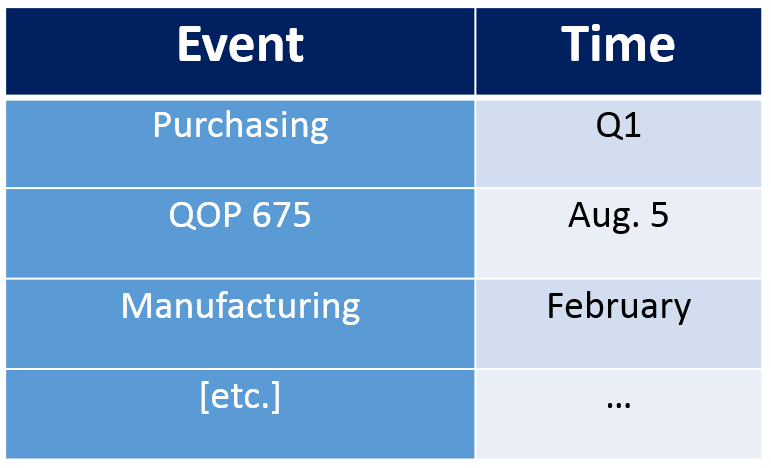
There are many styles and formats used in the wild to accomplish the task. Regardless of the format, the internal audit schedule will involve, primarily, some event occurring at some point in time.
Fig. 1
The events will be related to the requirements against which we are auditing; expressed perhaps as locations or documents or processes or some combination of these.
The time can be expressed as any calendar date, in any granularity that is consistent with the culture of the company. If I’m asked which time-frame resolution is best, and not given any other considerations, I will always say quarterly. Some corporate cultures dictate the schedules be defined down to the day – whatever works.
And, while you’ll not find any specific requirement for the time period in which a “full cycle”, or in which the entire scope of registration is covered – the correct answer is “within a calendar year”.
Options to consider
Process-based
Typically, the best audit schedules are process-based. What is a process? The fairly common definition says it is something that has inputs and outputs.
ISO 9001 defines it as “set of interrelated or interacting activities which transforms inputs into outputs”.
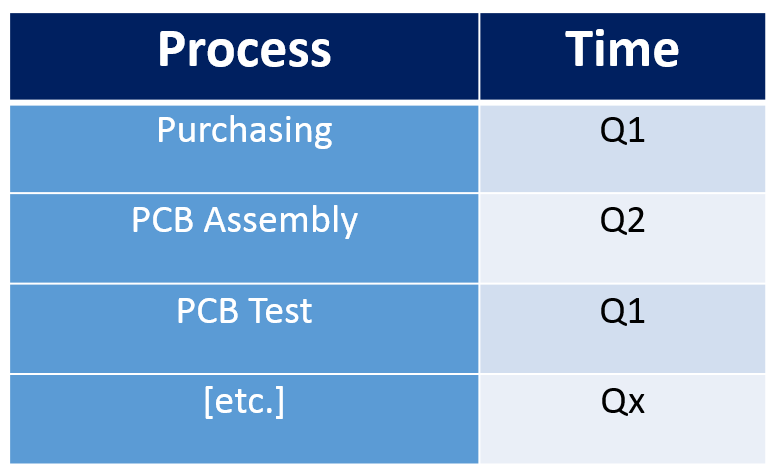
Fig. 2
Some processes are documented, some are not – the different standards each have requirements for what is to be formally documented and what is not needed to be.
The standard schedule looks pretty much like Figure 2.
Floor plan
This choice is an interesting one, and I like it. What it entails, simply, is to take a floor plan of the organization and section it off in slices of time. And this covers, in most implementations, about 80 percent of what needs to be covered – the rest earns an honorary position in the schedule (I will explain).
It is important to include all areas of the company; all buildings, including outbuildings and designated outdoor functional areas (storage, for example).
It is essentially a process-based audit, with a different way of illustrating it. So in this way, interrelated processes could easily be grouped together, especially if they are physically proximate.
This method makes it easy to see logistical inefficiencies as well, which is a nice bonus. While it makes sense to group Receiving, Incoming Inspection, and Stock Room, for example, if these blocks are scattered at the four corners of the map then a potential inefficiency becomes obvious.
Floor plan-based audits work best when there is a good balance between complexity and compartmentalization. If the processes are very complex, then they should be compartmentalized (there should be an inverse relationship between complexity and compartmentalization).
There are some areas, however, that need to be artificially, or “virtually” added to the Floor Plan schedule and these are processes which are not contained within a physical boundary. These would typically be support functions, such as preventive maintenance (in the case where there isn’t a dedicated department), or occasionally Information System support which is either performed by an outside provider, or through a corporate office. Improvement activities, such as continuous Improvement, Corrective Action, and Preventive action, as well as the Internal Audit function itself are also not typically located in a physical area. These are simply added to the schedule as a separate, virtual area.
Depending on the standard, other areas will need to be considered virtual as well.
How to ensure the full standard is covered in a Floor Plan-based Schedule
Once you’ve created your floor plan, take the standard; each clause and subclause, and make sure it has a counterpart on the layout. You should have to do this once, before you start using the system – and again each time the Internal Audit function is audited.
Document-based
What is meant by a document-based audit? Well, using the documents that have been created within the Management System as a basis for the audit. This would be distinct from using your ISO standard of choice (I’m going to leave that to third-party audits). Let’s discount this one out-of-hand.
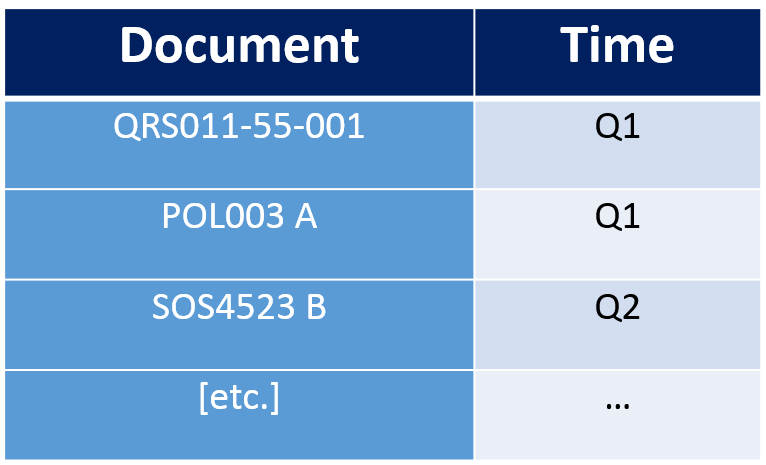
Fig. 3
Almost – baring two considerations. The first thing needed to do this is to include the Quality Manual as one of the documents used, with the caveat that the manual is of the sort that mirrors each requirement of the standard. I say this because some quality manuals are quite short (I know of one that is three pages long) – and as it stands now, ISO 9001:2015 won’t even require the use of a Quality Manual (though it will still be a convenient container for several sub-component requirements). Short manuals like mentioned above, are difficult to audit from without referencing the standard unless – here’s the second consideration, the management system has chosen to document every process. Not all standards require this (do any?), so this can be problematic.
If this is attempted then the schedule must include a provision to track the revisions of the documents over time, so nothing is missed (as I’ve shown in Figure 3).
Where this becomes problematic is when forms and other documents are involved. Should forms be included on the list? Or should there be an audit policy directing that whenever a document references another, then that document gets audited (and recorded) as well. It’s a bit of a logistical annoyance if you ask me. A document-based audit schedule is not my weapon of choice.
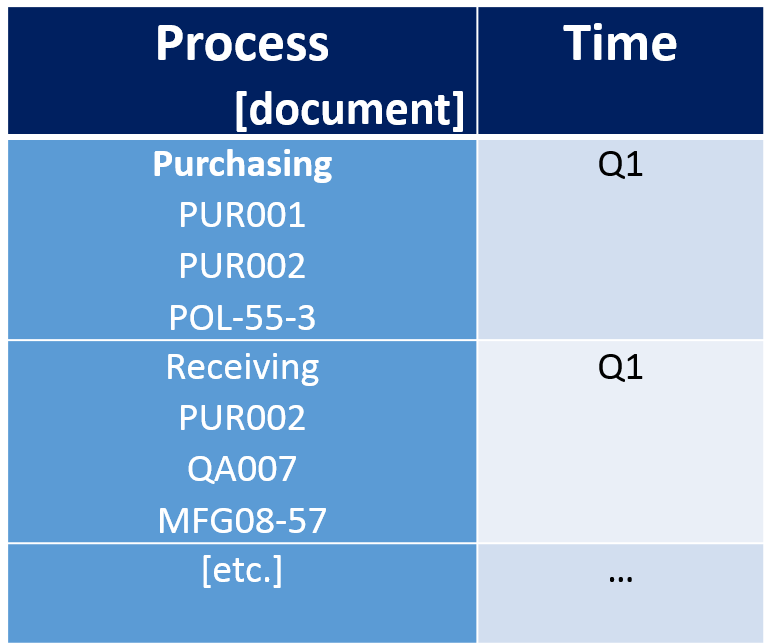
There is a hybrid of this and a process-based schedule that can work quite well, and that’s shown below (Figure 4).
Fig. 4
Risk-based
Definitely something to consider as risk management, or at least risk consideration becomes a familiar part of every ISO Management System standard.
The details of how this is done, along with a few other tidbits – will be covered in the next installment.
Hey – Hope you’re having a great weekend. This week there will be no talk of rice bowls – and I’ll get right to a recap.
Tuesday brought the second installment of “Toolsday” which began exploring the Audit Schedule; providing some background and establishing a foundation for Part 2.
Thursday we made an early look at the newly drafted Section 5, “Leadership” in the CD that will become ISO 9001:2015.
Behind the scenes, some updates to the security of the website (no, I am not throwing down the gauntlet!).
Also Investigated ways to make some ad revenue (very hard for me not to click my own links!) Costs money to keep these lights on and at this point maybe three people are reading this so – I know, “math is hard”. If you ever need anything from Amazon, the easiest way for you to help, is to enter Amazon using any link from this site – their search bar at right is handy. I know, advertisements are tedious. Welcome to America!
Oh, and working on getting a few podcasts up! I’m pretty excited about that.
Have yourself a great rest of the weekend, as well as a fine week. Drop me a message if you’d like something covered.
Thanks and go forth and calibrate thyself – tomorrow; take a day off from calibrating.