“Plans are nothing; planning is everything.” – Dwight D. Eisenhower
ISO 9001:2015, according to the latest Committee Draft (CD), has an entirely new layout and some new content. In the past, we’ve looked at section 4, “Context“, and then section 5, “Leadership“.
Continuing along in the series, here’s a look at the next section – section 6, “Planning“.
There are only three subsections, making the whole piece relatively short:
- “Actions to address risks and opportunities”,
- “Quality objectives and planning to achieve them”, and
- “Planning of changes”
Actions to address risks and opportunities requires that a company consider external and internal issues, referring to context and interested parties (see our preview of section 4), as well as determine the risks and opportunities implied by them.
Context, to save you a click, refers to both Internal and external context. External means issues arising from legal, technological, competitive, cultural, social, economic and natural environment. Internal refers to perceptions, values and culture of the organization.
As a result of these considerations the organization must assure that the intended outcomes of the QMS are achievable (implies that we know what the intended outcomes are, right?). Also, that product conformity (product = goods and services) along with customer satisfaction is maintained. As a result of planning, the company has to prevent, or reduce undesired effects and – improve.
With the above considerations in mind, an action plan is made to address risks and opportunities and this will include how to integrate (the standard actually says “implement”) these actions into the QMS.
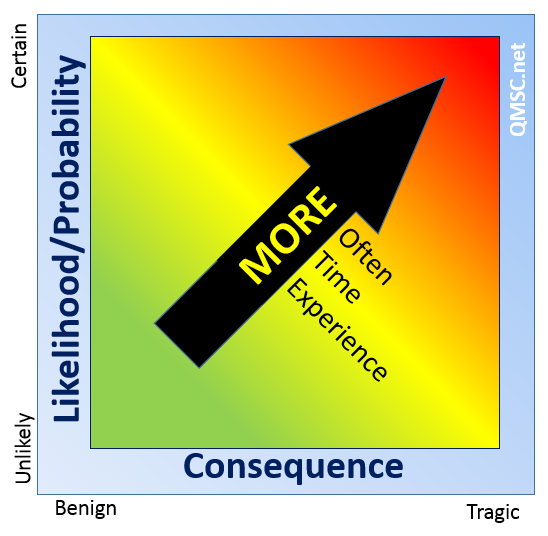 And, after doing that – the effectiveness of this plan must be evaluated. The standard goes on to say, essentially, that the actions must be proportionate to the effects. A note suggests avoidance, mitigation and acceptance as options for dealing with risk. Bigger risk should equal stronger planning.
You should come to the conclusion that somewhere along the line you’d need some way to measure the effectiveness of the plan, and have some basis on which to measure improvement.
Well, you’d be right, as the standard goes on to require that quality objectives be established at all “relevant” functions. This text is the same in the current version though in the 2015 the requirement becomes more formalized. Note that if you have a function, level or process without any objectives then you’d have to say that function, level or process isn’t relevant – if that is so, then why have it? (“Will all non-essential personnel please report to the parking lot…”)
The last bit within section six relates to handling changes – and that changes shall be planned. Again, an expansion of a current requirement.
A few examples of possibly applicable changes:
- New management or management representative,
- New ownership or partner,
- Different context (internal or external),
- New machinery,
- Alien invasion (good luck!).
New situations must be accounted for, and a plan developed (glasses of water – everywhere).
Section Summary
Let’s try and summarize all that. Is the standard now asking for a document called “Quality Plan”? I vote “nope”, or “mostly nope” – in the case of a change, there will likely be something documented specific to the event. In most other situations, though, “Plan” can be either a noun, or a verb (as has always been the case).

For some, it will be an actual document, or a set of documents specific to a product or process that includes all of the considerations prescribed (noun). Some of you may know of the concept of “Control Plan” – this would be something like that. Generated for a specific product, or prior to each job, for example. A job router may serve this purpose, if it indeed considers what needs considering.
For others, the system itself; the various procedures, work instructions, machinery etc. – is the result of the exercise in planning (verb). “We planned, taking into consideration risk and opportunities, etc. etc. – and we came up with THIS.” a broad sweep of the arm to indicate the factory space and the documented system that describes and controls it.
There really isn’t a new requirement here – an added level, I hesitate to call it a burden, of record keeping perhaps – something showing the risks and opportunities and metrics measuring how the processes are behaving in light of them.
There will be some initial head scratching, but I think this section will be relatively easy to implement.
Thanks for your attention; go forth – calibrate thyself. Or – come up with a plan first, then calibrate thyself.
Sal
 The section starts out with “Leadership and commitment” and that it shall be demonstrated. One might ask how – well, specifically by eight methods. I’ve decided not to hash into the three that already exist (almost verbatim) as requirements in ISO 9001:2008, but there are a few differences or at least accentuations of previous focus: